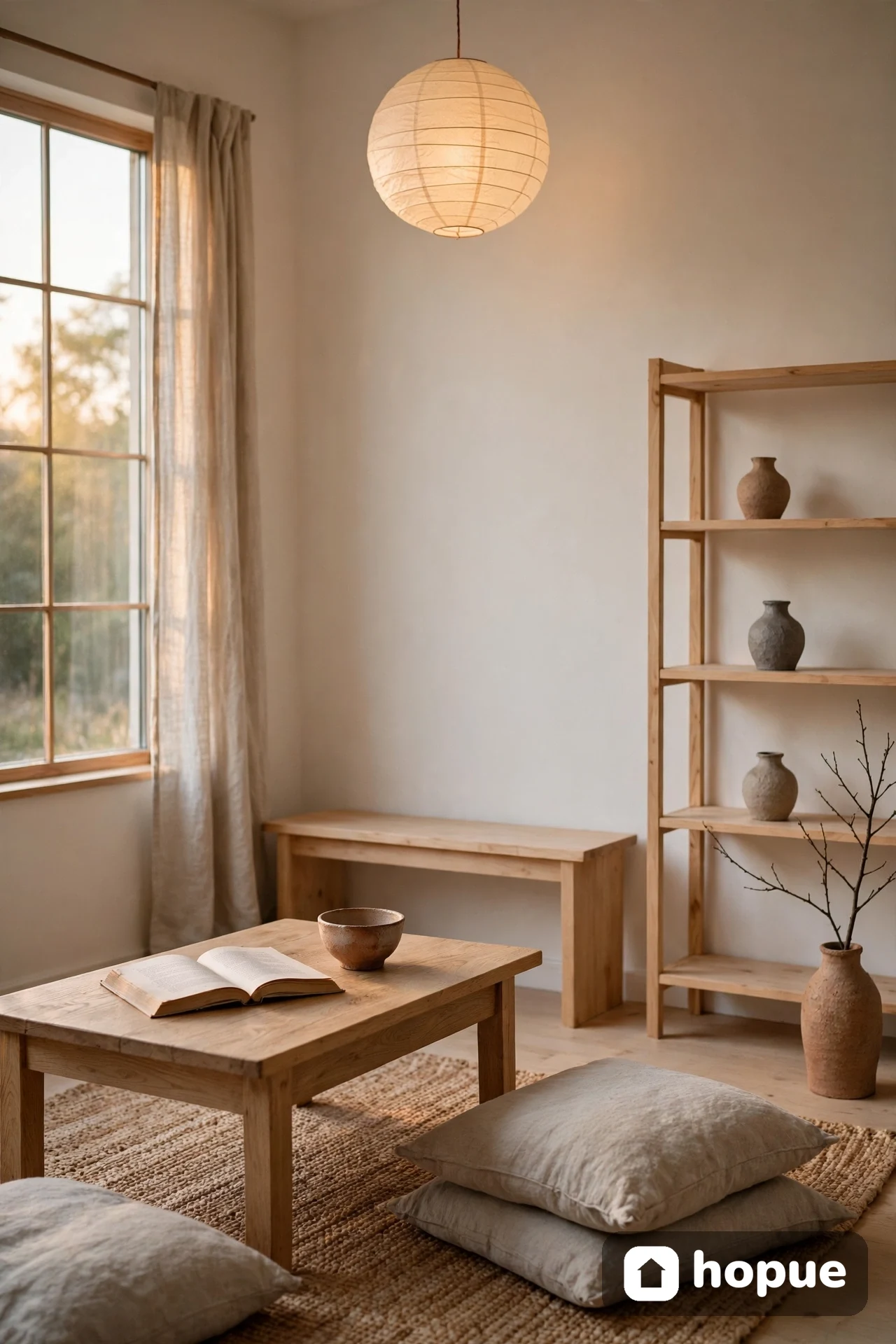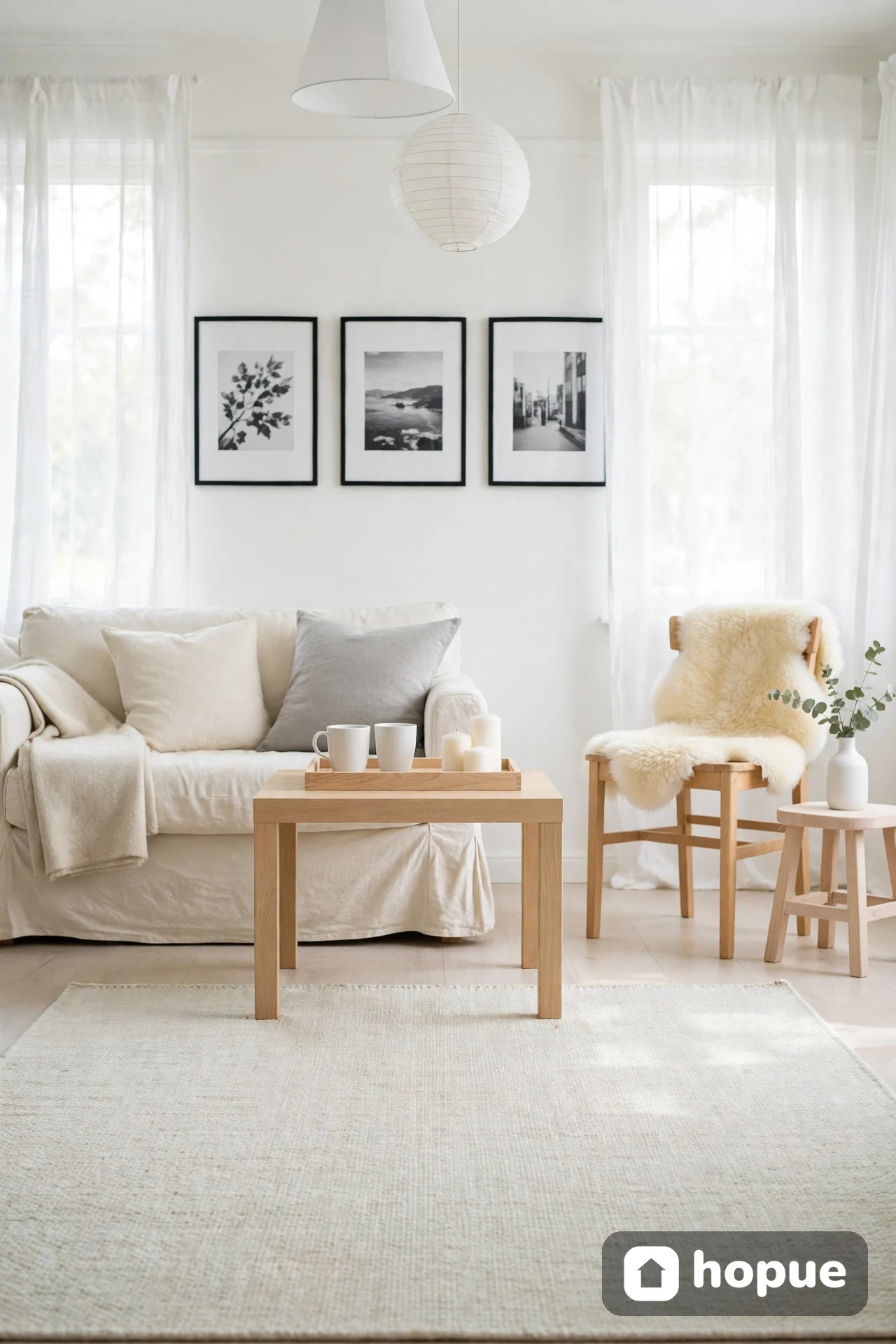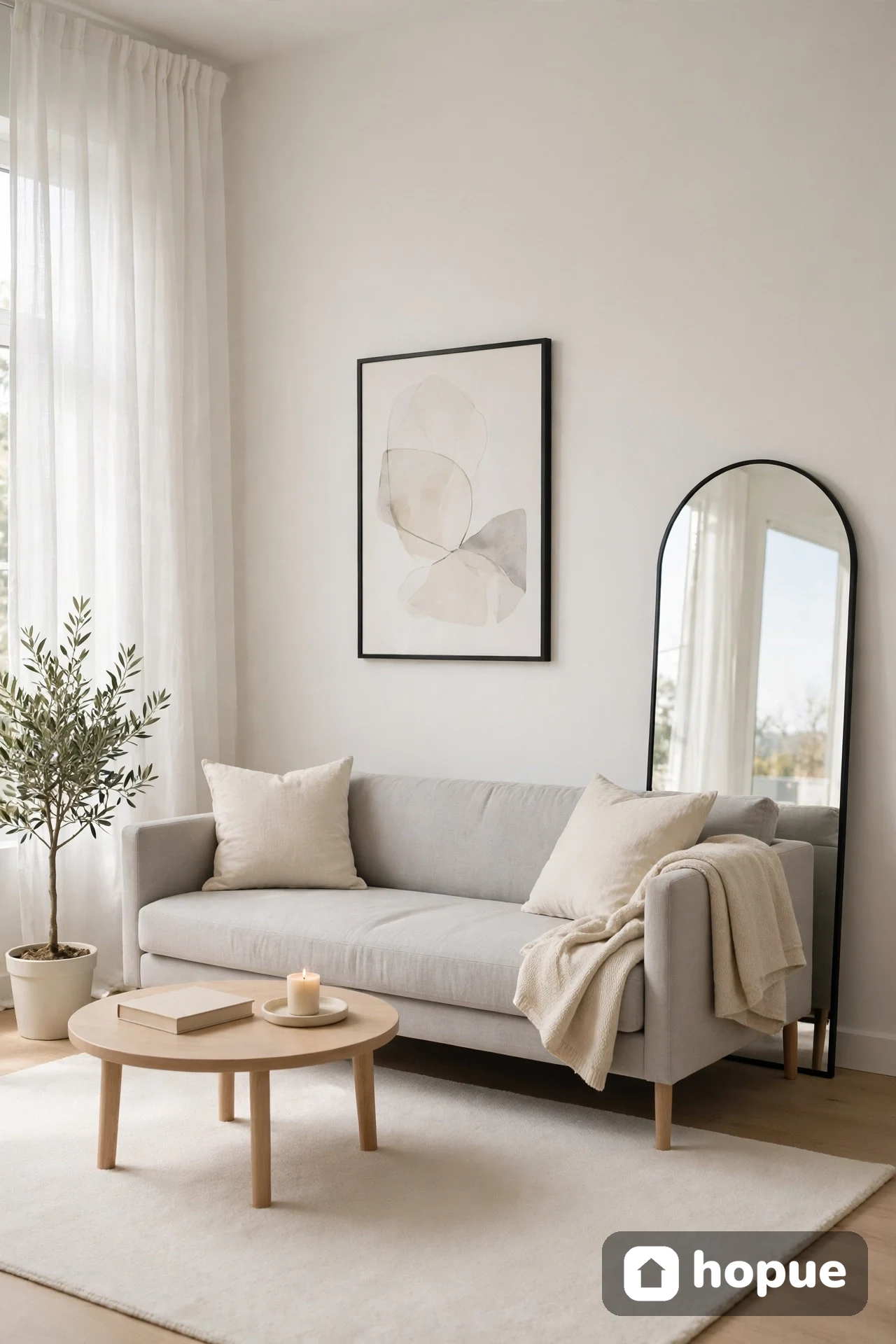
29 Coffee Table Styling Ideas for a Small Living Room
When I typed “coffee table styling small living room” into search during my first rental, every photo showed a table the size of a dining table, in a room with space to walk all the way around it. Mine was not that table. Mine held my coffee, my laptop, my mail, and a plant I was trying not to kill, all at once, in a living room where the sofa nearly touched it. If that sounds familiar, this list is for you. A small table has to work harder than a big one, and styling it is less about filling it up and more about deciding what earns a spot.
You do not need to buy a whole new set of objects to make it look good. Most of the ideas below use things renters already own — books, a tray, a mug, a plant — and none of them ask you to drill, paint, or change the furniture itself. Pick two or three to start, live with them for a week, and keep only the ones that still make sense when you are actually sitting there with a cup in your hand.
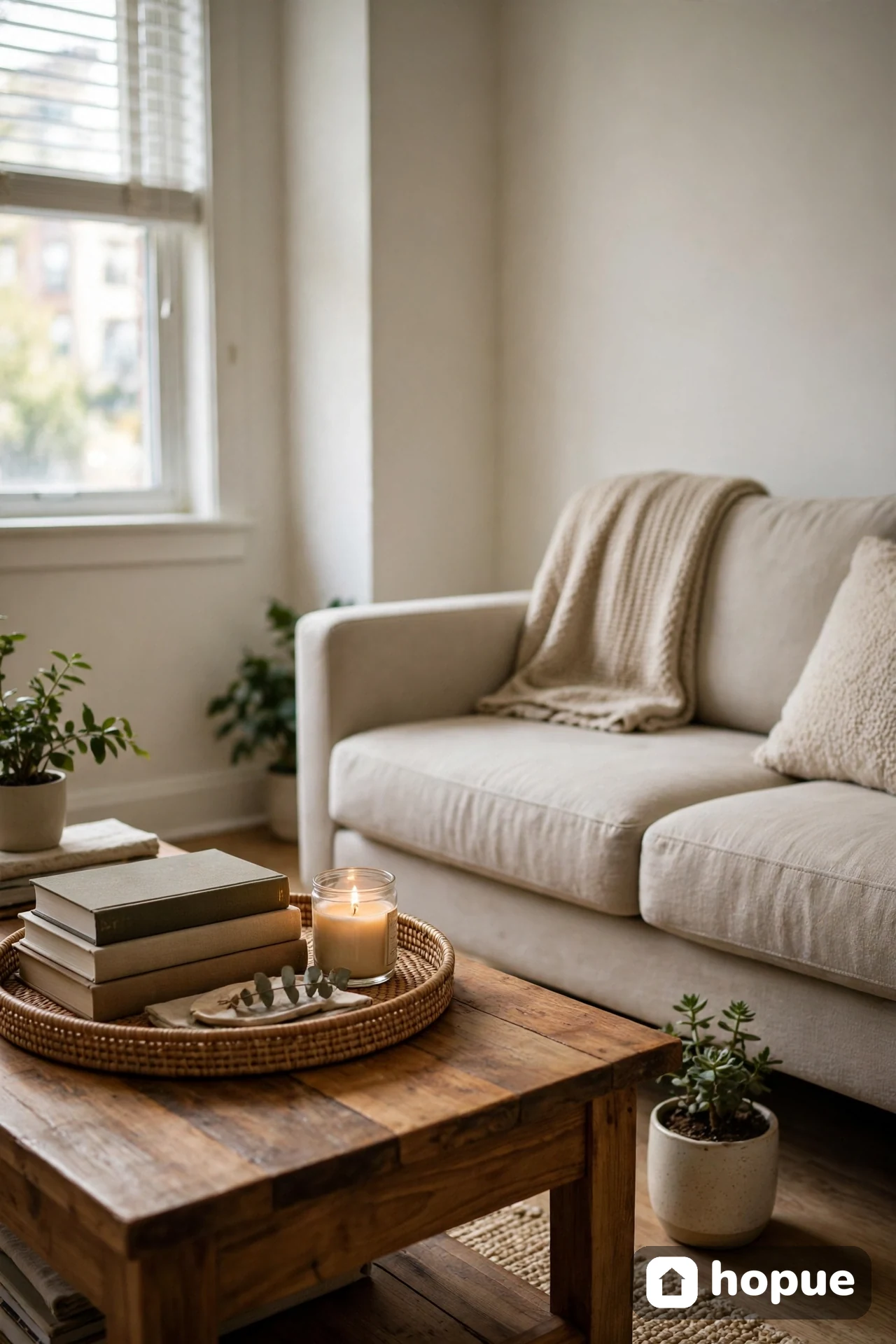
1. Start With a Tray as the Anchor
A tray does the quiet work of turning a pile into a group. Put your candle, a small plant, or your remote box on it, and the rest of the table stays free for real life.
I used a cheap wooden tray from a thrift shop for two years. It had a scratch on one corner and I liked it more for that. When friends came over, I lifted the whole tray off, set drinks down, and put it back when they left. No restyling. No fuss.
2. Stack Books Flat, Biggest on the Bottom
Books laid flat take up less visual room than books stood up, and they give you a base for one small object on top. Start with the biggest book at the bottom and work up to the smallest. It sounds fussy, but a stack that leans or wobbles will bug you every time you walk past. Keep the stack to two or three books. Any more and it starts to look like a pile you meant to put away. Leave the top book with its cover showing if you like the color, or turn it spine-out if the cover clashes with the room.
3. Leave One Corner Empty on Purpose
This one feels wrong at first. You see an empty corner and want to fill it. Don’t.
That empty corner is where your mug, your phone, or a bowl of snacks lands without you having to move three things first. I keep the corner closest to my usual seat empty. It is not the prettiest corner. It is the most useful one, and I notice it every evening.
4. Add One Small Plant You Can Actually Keep Alive
One plant is enough. Pick the kind that forgives you — a pothos, a snake plant, something that does not sulk if you forget it for a week. Put it in a pot you like looking at, because the pot is what you will see most days, not the leaves. A trailing plant works well on a low table because the leaves soften the hard edges without taking up much surface. If your living room gets almost no direct light, be honest about that before you buy. A fake plant you like is better than a real one slowly giving up in the corner.
5. Give Candles a Sturdy Home
Candles look cozy in photos. They cause small disasters in real apartments when they tip.
Use a heavy holder, a wide dish underneath, or a candle with a lid you can close. I stopped using tall, skinny taper candles on my coffee table after one leaned over during a movie night. A short, chunky candle in a glass jar stayed put and did not make me nervous when I reached for the remote. Keep matches in a small dish nearby, or use a lighter you can find without digging. And if you have a cat, skip the open flame and use a battery candle. It still glows.
6. Add One Tall Thing for Height
Most coffee table objects are low and flat. Books, trays, bowls — they all sit at about the same height, and the table can start to look like one long, low line. One taller object breaks that up. A slim vase with a few branches, a tall candle holder, or a small stack that stands a bit higher than the rest will do it. Nothing dramatic. Just enough height that your eye stops somewhere instead of sliding straight across. Watch the sight line to the TV, though. If the tall thing blocks the screen from your usual seat, move it to the far side.
7. Mix a Round Object With Straight Lines
Coffee tables are rectangles. Sofas are rectangles. Rugs are rectangles.
One round thing changes that. A round bowl, a round tray, or a round coaster set softens all those corners without new furniture. I noticed it by accident, when a round wooden bowl landed on a square table and the whole corner looked less stiff. One round shape is enough. On the table itself, a bowl or tray is simpler than a leaning mirror, and less likely to fall.
8. Hide Remotes and Chargers in a Lidded Box
Remotes multiply. So do charging cables. A small box with a lid — wood, woven, or even a sturdy cardboard box covered in fabric — hides both and still looks like decor. Keep the box on one side of the table, not in the middle, so you are not lifting the lid every time you want to change the volume. I kept my spare charger coiled inside mine, with the end poking out just enough to grab. Guests thought it was just a decorative box. That was the point. When it gets messy inside, close the lid. Out of sight still counts.
9. Keep Coasters Out Where You Will Use Them
Coasters hidden in a drawer do not protect anything. Keep a small stack right on the table, in a holder or just in a neat pile, where you can reach them without thinking. If they look good, they count as styling. Cork, wood, stone, woven — pick the kind that suits the table you have.
On a rented wood table, coasters are not optional decor. They are how you get your deposit back. I learned that after a hot mug left a pale ring on a table I did not own. Now the coasters live out in the open, and I actually use them.
10. Put a Small Dish to Work for Everyday Bits
A shallow dish, about the size of your hand, catches the small things that otherwise scatter: hair ties, a spare key, loose change, a lip balm. Without a dish, those bits end up in a line across the table and make the whole surface look messy even when it is not. With a dish, they look contained. Use a dish you already have — a saucer, a small plate from a set you never use, a thrifted ceramic bowl. Put it near the edge closest to where you sit down. If the dish fills up, empty it. A dish is a holding spot, not a junk drawer with no lid.
11. Lay Something Soft Under the Tray
A folded cloth, a small runner, or even a placemat under a tray adds a layer without adding clutter. It also protects a rented tabletop from scratches when you slide the tray around. I used a linen napkin I already owned, folded in half, under a wooden tray. It softened the look, and the tray stopped sliding every time I set a mug down on it. Keep the cloth flat and simple. A busy pattern under a busy tray will fight for attention. One quiet layer is enough, and you can swap it out when you wash it without restyling anything else.
12. Let One Object Change With the Season
Pick one object to swap as the seasons change, and leave the rest alone. Four full sets of decor is a lot to store in a small apartment, and most of it would sit in a closet anyway.
In fall, that one swap might be a small pumpkin or dried leaves in a vase. In winter, a pinecone or a sprig of greenery. In spring, a fresh bunch of flowers. The swap takes five minutes, it costs little or nothing if you use what is outside or on sale, and it keeps the table from looking frozen in one month all year. I keep a small vase for this job and change only what goes in it. The tray, the books, and the box stay put.
13. Lean a Small Frame Instead of Hanging It
Renters know the wall-drilling dance. A small framed photo or print leaned against a stack of books, or against the wall behind the table if the table sits close to it, gives you a personal touch with no holes. Lean it at a slight angle so it does not slide, and keep the frame small enough that it does not dominate the table. A photo from a trip, a postcard, a print you actually like — not a generic quote you bought because the frame was on sale. I leaned a photo of my grandmother’s kitchen on my table for a year. People asked about it more than anything else in the room.
14. Group in Threes, Not in a Straight Row
Three objects close together read as one arrangement. Five spaced out in a row read as clutter, even if each one is nice on its own.
Try a tray, a candle, and a plant clustered on one side, with open space on the other. Or books, a bowl, and a small vase together. If you catch yourself lining things up like soldiers along the back edge, pull two forward and one back. That small shift makes the group feel lived-in instead of staged.
15. Keep Breakables Away From the Edge
In a small living room, knees bump tables. Bags get set down hard. Someone reaches for the remote and knocks a glass. Put anything fragile — a thin vase, a ceramic figurine, a glass candle holder — toward the center or the back of the table, not right at the edge where an elbow will find it. This is not just about looks. It is about not sweeping up glass at midnight. I moved my favorite vase to the middle after it survived two near-misses in one week. It looked just as good there, and I stopped flinching every time someone stood up.
16. Leave a Game Out and Ready to Play
A deck of cards, a small puzzle, or a board game left open on the table invites people to actually use the living room. It also tells the truth about how you live, which is more interesting than a table that looks like no one ever sits there. Keep the game in its box or on a tray so the pieces do not scatter, and pick one that fits the table size. A huge board game on a tiny table just gets in the way. A card game or a small puzzle fits, stays tidy, and gives guests something to do while dinner cooks. When it is not in use, it still looks like part of the room.
17. Pick Books You Would Actually Open
A cookbook you cook from. A photography book from a place you visited. A book about a hobby you have. Those spark conversation because you can talk about them.
A book bought only because the cover matched the sofa does not. No one opens it, and after a while you notice. Stack one or two real favorites where you can reach them. Dog-eared pages and a cracked spine are fine. They show the book is used, not just displayed, and in a small apartment that honesty reads as warmth, not mess.
18. Use the Floor Space Under the Table
If your table has open space underneath, that space counts too. A low basket under the table can hold a folded throw, magazines, or the extra blankets you reach for on cold nights. It keeps those things close without piling them on top. Make sure the basket slides in and out easily and does not stick out past the table edge where you will trip on it. I kept a basket of throws under mine, and on winter evenings I did not have to get up and cross the room to grab one. The top stayed clear, and the basket looked like it belonged there.
19. Repeat One Color From the Sofa or Rug
Pick one color that already exists in the room — the rust in a throw pillow, the deep green in the rug, the warm wood of a shelf — and repeat it once on the coffee table. A vase in that color, a book cover, a candle, a small bowl. One repeat ties the table to the rest of the room so it does not look like it drifted in from another apartment.
Two or three repeats start to feel like a theme park. Keep it to one clear echo, and let everything else stay neutral. If you change the throw pillows later, swap that one object too.
20. Make Room for Your Mug and Your Laptop
Styling that leaves no room to actually use the table will not last a week. Before you call it done, sit down in your usual spot and set down what you normally hold: a mug, a laptop, a notebook, a plate. Is there space without moving three styled objects? If not, pull one object off. A coffee table in a small apartment is a work surface, a dining surface, and a footrest on tired days, sometimes all in one evening. The styling has to survive that. I test every arrangement by eating dinner at the table. If I have to clear half of it to fit a plate, the arrangement is too precious for my life.
21. Keep a Notepad and Pen Within Reach
A small notepad and a pen on the table save more trips than you would think. Grocery lists, a phone number someone reads out, an idea at midnight — they all land somewhere, and the coffee table is usually the nearest flat surface. Keep the notepad small and the pen attached or tucked under it so it does not roll off. A pretty notebook works, but a plain pad you will actually write in works better. I used to lose pens constantly until I kept one in a small cup with the notepad beside it. It looked tidy, and I stopped writing lists on the back of envelopes.
22. Try a Small Riser to Lift One Object Up
A riser lifts one object a little higher than the rest. A small wooden stand, an upturned bowl, a thick book used as a base — any of those will do.
Put your plant or candle on it, and that object gets noticed. Without a riser, everything sits at the same level and blends together. Keep the riser stable and wide enough for what sits on it. A wobbly riser is worse than no riser at all. I tried a cutting board once. It worked until someone bumped it. A proper stand with a flat base stayed put, so that is the one I kept.
23. Keep a Carafe and Glasses Ready for Guests
If you host even now and then, a small carafe and two glasses on a tray say “sit down, stay a while” better than any decorative object. Fill the carafe when people arrive; the rest of the time, the empty glasses and carafe still look intentional. Keep them on the tray so water rings stay contained and you can move the whole set to the kitchen in one trip. This works best if you actually use it. A carafe that sits dusty for months just takes up space. Mine gets used most weekends, so it earned its spot. If you never host, skip this one and leave the space for something you do use.
24. Split One Grocery Bunch Across Two Vases
Buy one bunch. Split it in two.
One bunch of grocery store flowers, divided between two small vases, looks fuller than one big bunch jammed into one vase. Put one vase on the coffee table and the other on a shelf, a windowsill, or the kitchen counter. On the table, keep the stems short so the flowers do not block conversation or the TV. Trim a few stems, spread them out, and let the vase do half the work. Flowers do not last forever, and that is fine. For the few days they are fresh, they change the whole room. When they fade, toss them, and the vase waits for the next bunch.
25. Mix Materials So the Top Does Not Look Flat
Wood, glass, ceramic, woven fiber, metal — when everything on the table is the same material, the surface looks flat even if the shapes are different. Mix two or three materials and the table gains depth. A wooden tray, a ceramic vase, and a glass candle holder, for example, each catch light differently. You probably own this mix already. Look around the apartment before you buy anything new. A woven basket from the closet, a metal box from a desk, a stone coaster set — they all count. Keep the mix to a few materials, though. Every material under the sun on one small table reads as a yard sale, not a styled surface.
26. Style the Lower Shelf Like a Second Surface
Some coffee tables have a lower shelf, and most people either leave it bare or pile it with whatever does not fit on top. Treat it as a second, quieter surface instead. A row of magazines, a couple of books laid flat, or a single basket fits the shelf without crowding it. Keep the shelf lighter than the top — fewer objects, lower height — so the table does not look top-heavy or bottom-heavy. And leave space to slide things in and out. If you have to wrestle a magazine free every time, you will stop using the shelf. I kept two magazines and a thin basket there, and nothing else. It stayed tidy because there was not room for it to get messy.
27. Swap One Thing Out Every Couple of Weeks
A table that never changes starts to disappear. You stop seeing it.
Swap one small thing every couple of weeks — a candle for a vase, a book for a different book, a photo for a postcard. I do it on laundry day, when I am already tidying. One object out, a different one in. The table never looks completely new, which is good. It looks lived-in.
28. Clear It Completely Before Bed
Once a day, take everything portable off the table, wipe it down, and put back only what belongs there. Mugs to the kitchen. Mail sorted. Remote back in its box.
It sounds like extra work. It takes less time than a full clean later, and you wake up to a table that looks like you meant it. In a small apartment, the coffee table is the first thing you see in the morning. I started clearing mine after a week of waking up to yesterday’s snacks and a cold cup of tea. Clearing it nightly fixed the mornings too.
29. Step Back and Check It From the Doorway
Style the table, then walk to the doorway and look at it from there. That is how guests see it, and how you see it when you walk in. From the door, clutter shows up fast. So does an arrangement that looks good up close but lopsided from a distance. Check for three things: does one side look heavier than the other, is anything blocking the walkway, and does the table still look like a place to sit? Adjust once, then stop. I used to fuss with my table for twenty minutes and make it worse. One doorway check, one small fix, and I leave it alone. The table is done when it looks good from the door and works from the sofa.
A good coffee table in a small living room does not need to look like a photo. It needs to hold your coffee without a wobble, hide the remote when you want it hidden, and still have room for dinner on a tired Tuesday. Start with a tray and an empty corner, add one thing you love, and let the rest earn its place over time. The tables that feel best are rarely the fullest ones. They are the ones where everything on top has a job, and there is still space left for the person sitting next to it.
Frequently Asked Questions
My coffee table is tiny — barely room for a mug. What should I leave on it?
Leave one thing, maybe two, and keep the rest clear. A small tray with a candle, or a single stack of two books, is plenty on a very small table. Skip the plant, the box, and the vase all at once, or the table will have no room left to use. Put the extra pieces on a nearby shelf or windowsill instead, where you can still see them. A tiny table styled lightly looks deliberate. A tiny table piled high just looks small.
How do I keep a styled coffee table looking good when I work from the sofa all day?
Give your work gear one defined spot and one clear rule: it lives there during work, and it leaves when work ends. A laptop on the empty corner from idea 3, a charger in the lidded box from idea 8, and a mug on a coaster is a work setup that still looks tidy. At the end of the day, close the laptop, coil the charger into the box, and take the mug to the kitchen. If papers spread, keep them in a single folder on the table instead of loose. The table does not have to stay photo-ready all day. It just needs a reset that takes a minute.
My rented coffee table is scratched. Can styling hide that without damaging it more?
Yes, and a tray or a cloth layer does most of the work. A tray covers the worst scratches in the middle, and a folded cloth under it covers more while stopping new scratches when you slide things around. Coasters under every mug and glass stop the rings from getting worse. Avoid stick-on covers or anything with strong glue on a rented table, since those can leave marks of their own when you peel them off. If a scratch is deep, a tray placed over it is a better fix than a marker or a filler that might not match. When you move out, lift the tray and the table looks the same as it did when you moved in.
My cat knocks everything off the table. What can I safely leave out?
Keep it low, heavy, and hard to push. A heavy tray, a chunky candle in a jar with a lid, a stack of books, and a plant in a heavy pot are much harder for a cat to knock over than a tall thin vase or a light figurine. Skip open flames, skip anything fragile near the edge, and skip small objects a cat can bat across the room. Put the plant in the center, not at the corner where a cat jumps up. And accept that some days the cat wins. Style for the cat you have, not the cat in the photo, and keep anything precious on a higher shelf instead.