29 Oversized Wall Art Ideas for a Small Apartment
A small apartment does not need a wall full of little frames to feel finished. Sometimes it needs the opposite: one large piece that takes up real space and gives the room a clear focal point. When every print is small, the eye keeps moving and nothing settles. One oversized piece settles it. It tells you where the living area is, where the bed belongs, or where to look when you walk in the door, and it does that without adding clutter to shelves, floors, or tabletops you already need for daily life.
I learned this the slow way in my first studio. I had four small prints clustered over the sofa, and the wall still looked bare. The prints were fine on their own, but together they looked lost against all that blank paint. A friend gave me a large canvas she no longer wanted — nothing fancy, just soft shapes in blue and cream — and the whole room changed the day I put it up. It was not about spending more. It was about scale. The ideas below are built around that lesson, for renters, for tight budgets, and for walls you have to hand back in good condition. Each one is about a single oversized piece, not a gallery wall and not a mirror, and each one works in a real small apartment where space, light, and lease rules all matter.
1. Anchor It Over the Sofa
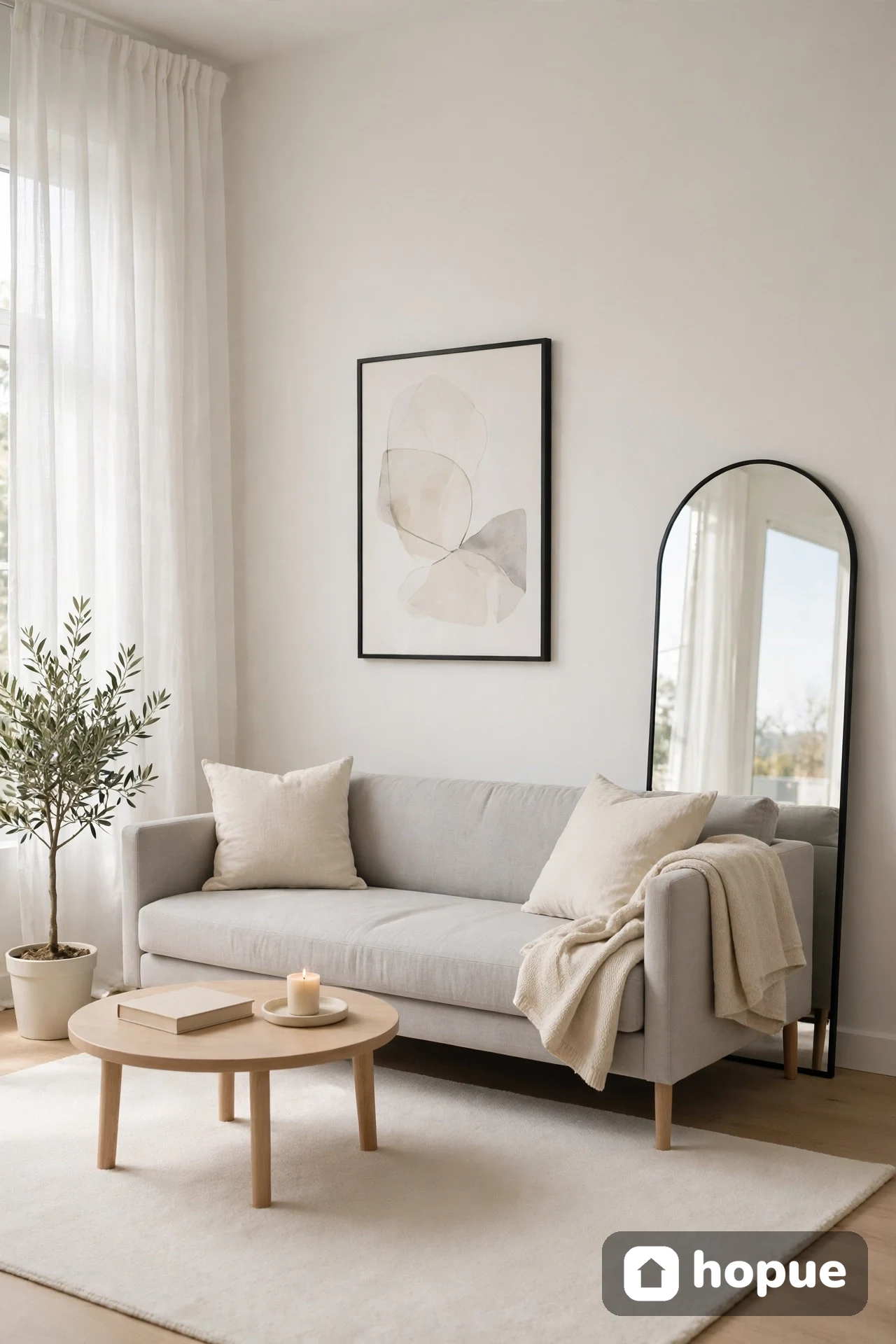
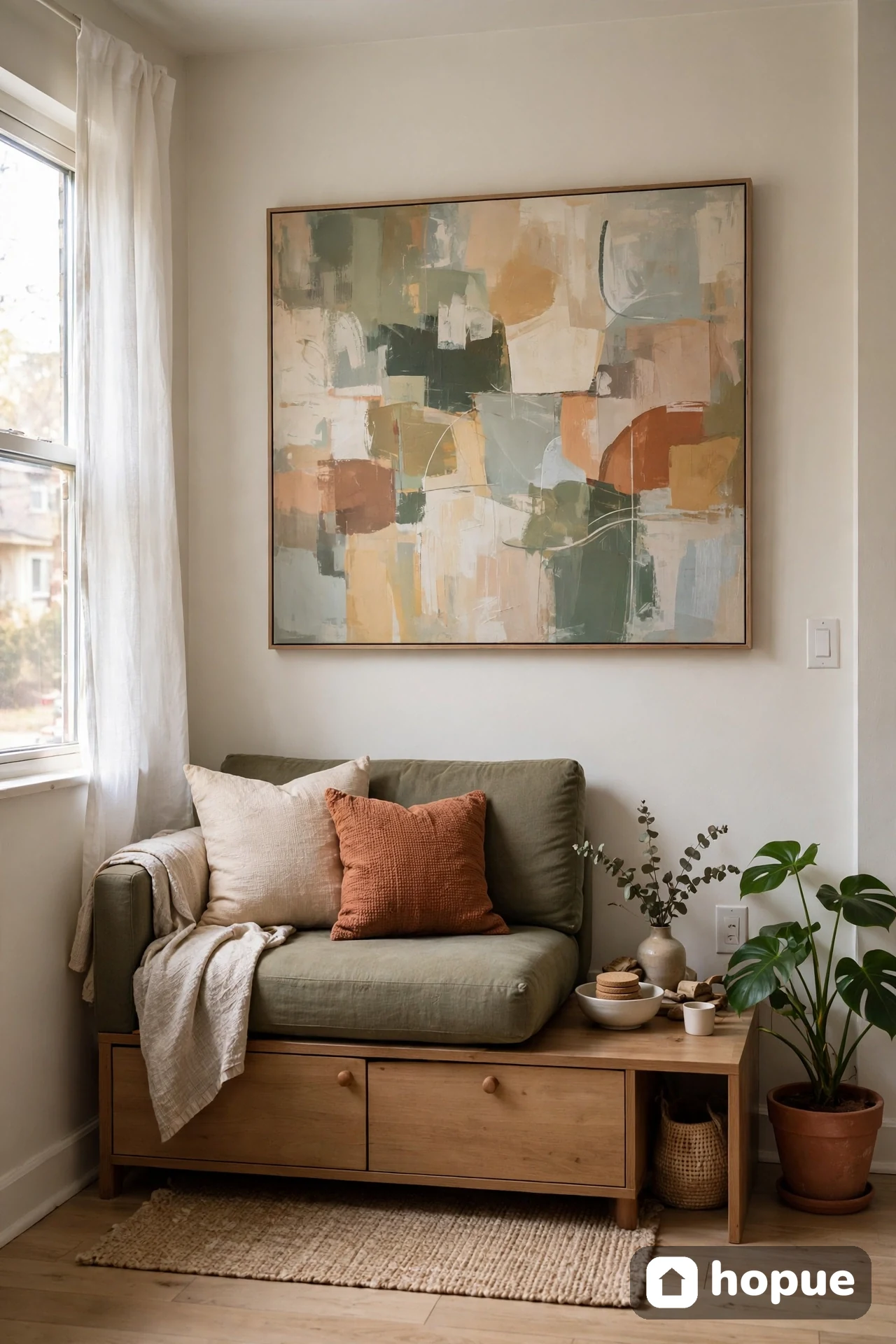
Start with the wall most people see first. A large piece over the sofa gives the seating area a backbone. It should feel connected to the sofa below it, not floating far above on its own. Leave some breathing room between the top of the sofa cushions and the bottom of the art, but not so much that the two look unrelated. Check it from the doorway, not from two feet away. If the art and sofa read as one grouping, you have it right. If the art looks like it belongs to the ceiling, bring it down a little. This is the safest first spot to try oversized art because the sofa already sets the width and the mood of the room.
2. Lean It Instead of Hanging It
Leaning is the renter’s friend, especially for a heavy or very tall piece. Set the bottom edge on the floor, tilt the top back against the wall, and let gravity and friction do most of the work. I have done this behind a sofa and beside a bookcase, and it always looks a little more relaxed than a hung piece, like the art just arrived and decided to stay.
Use felt pads where the frame meets the wall so it does not scuff the paint. If you have small kids, a large dog, or a wobbly floor, add a discreet anchor at the top or choose a lighter piece to lean. A leaned piece is also easy to move when you rearrange, which happens a lot in a small place.
3. Use One Piece as a Headboard
No headboard? A wide, oversized piece over the bed can do the job. It marks the sleeping area, softens a plain wall, and saves the floor space a real headboard would take. Canvas works well here because there are no hard corners at head height and the surface is forgiving if a pillow presses against it. Keep the bottom edge clear of the pillows so bedding does not rub the art every night. Pick something calm to look at last thing at night and first thing in the morning. A busy, high-contrast image over the bed can feel loud when you are trying to wind down. One quiet, large piece is usually enough.
4. Fill the Wall Above a Small Dining Table
Dining corners in small apartments are often the most forgotten wall in the home. A table pushed against the wall, two chairs, and nothing above them. One oversized piece fixes that fast. Center it over the table rather than over the whole wall, since the table is what you actually use there. A food-friendly subject is not required — an abstract, a landscape, or a simple color study works just as well and will not date as quickly. Avoid hanging anything too delicate right where steam, splashes, or chair backs can reach it. A framed print with glass, or a canvas you can wipe gently, will hold up better than an unprotected paper print in a spot where people eat every day.
5. Go Tall in the Entryway
Entryways are narrow, and that is exactly why a tall, vertical piece works there. A wide piece would crowd the door swing or fight with coat hooks. A tall one uses the height you already have and gives guests something to look at in the first few seconds inside. I once hung a narrow, oversized botanical print in a hallway entry so thin I could touch both walls at once, and visitors noticed it before they noticed how small the space was.
Keep the bottom clear of shoes, bags, and the bench if you have one. If your entry has a light switch or thermostat on that wall, work around it rather than covering it. The art should make arrival feel intentional, not like an obstacle course.
6. Pair It With a Low Console
A low console, sideboard, or long bench under a large piece creates a complete vignette with very little furniture. The art provides height, the console provides a surface, and the space between them stays clean. Try one lamp on the console, or a small stack of books, and then stop. Too many objects on top will compete with the art and make the whole wall feel busy again. The console does not have to match the art exactly. A wood console under a cool-toned abstract, or a black console under a warm landscape, can look more collected than a perfect match. What matters is that the widths relate to each other and neither piece overwhelms the other.
7. Choose a Big Photograph, Not a Painting
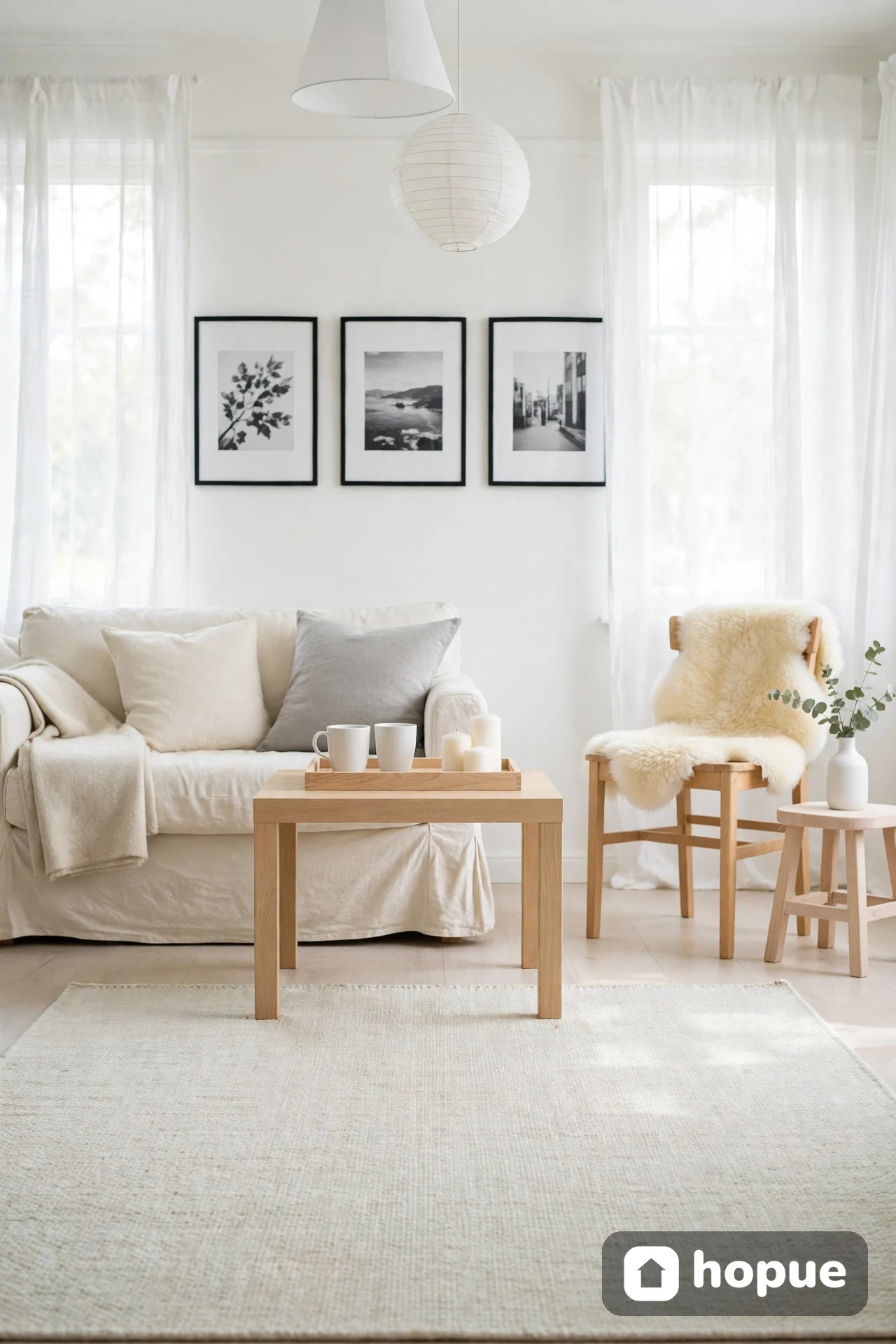
Some rooms feel better with a photograph than with paint. A single oversized photograph — a street scene, a coastline, a quiet interior, a portrait of a place you love — brings a sense of reality that an abstract cannot. If you have a favorite photo from a trip, a family walk, or even your own neighborhood in good light, a large print of it can be deeply personal without costing what an original painting would. Print it in black and white if the color version feels too busy. Black and white also forgives a mixed-color room, since it sits calmly beside a patterned rug or colored sofa. Ask the print shop about matte finishes if glare is a problem in your room.
8. Let a Light, Airy Abstract Do the Work
Worried that a huge piece will close the room in? Choose one with plenty of pale background and soft shapes. Light abstracts read as air, not as weight. They fill the wall without darkening it, which matters in apartments where the only window faces another building. Aim for pieces where the color sits in one or two areas and the rest stays quiet — cream, pale gray, soft sage, washed-out blue. Hang it where it can catch some daylight and it will feel like part of the wall rather than something pasted on top of it. My rule of thumb, learned after one very dark purchase I regretted: if the art looks heavy in the shop, it will look heavier at home.
9. Pick a Wide Landscape to Stretch the Room
A wide landscape with a clear horizon can make a short wall feel longer. The eye follows the horizon line across the piece, and the room seems to open in that direction. That horizon pull helps most on the long wall of a studio or above a sofa that faces the door. Choose a scene with distance in it — fields, water, a road, a low skyline — rather than a close-up that stops the eye at the surface. A landscape does not have to be realistic to do this. A simple, layered abstract landscape with bands of color for sky, land, and water gives the same sense of depth. Keep the rest of the wall bare so the horizon has room to breathe.
10. Make One Bold Color the Room’s Anchor
If your furniture is mostly neutral, one bold piece can carry all the color the room needs. A deep green, a warm terracotta, a strong blue — pick one and let the art hold it. Then echo that color in just one or two small places, like a cushion or a throw, so the room feels planned rather than random. Do not try to match the color exactly in every object. Near matches look intentional; exact matches everywhere can look like a set from a catalog. A bold piece also gives you a shortcut when you move. The art goes up first in the new place, and everything else finds its place around it. That one decision settles a lot of smaller ones.
11. Hang It Where the Light Lands
Light changes how oversized art looks through the day, so placement matters as much as the image itself. A piece on the wall opposite a window gets soft, even light for much of the day and is easy to see from across the room. A piece beside a window gets raking light that shows texture beautifully in the afternoon. Watch out for two problems: direct sun, which can fade prints and textiles over time, and glare on glass, which can turn a framed piece into a mirror at certain hours.
Stand where you usually sit and check at different times before you commit to holes in the wall. I moved one large print twice in a rental before I found the wall where I could actually see it after lunch. The third spot was the one I should have tested first.
12. Frame a Large Budget Print Simply
You do not need an expensive original to fill a wall well. A large print in a simple, thin frame often looks better in a small apartment than an ornate frame that eats up visual space and budget. Look for prints from independent artists, museum shops, or print-on-demand sellers, and pair them with a plain wood or black frame that does not fight the image. A wide mat can help a smaller print feel larger, but with a truly oversized print, skip the mat and let the image go nearly to the edge of the frame. That edge-to-edge look reads modern and makes the most of the size you paid for. Check the frame corners and hanging wire before you hang it — budget frames sometimes need a sturdier wire or an extra bracket.
13. Try an Oversized Fabric Hanging
Fabric is the lightest way to go big. A large textile hanging — woven cotton, linen, or a printed cloth — weighs far less than a framed canvas of the same size, folds flat when you move, and softens sound in a room with hard floors. Hang it from a wooden dowel, clip it with simple clips, or use a sleeve sewn along the top. Fabric moves slightly with air and touch, so keep it away from doorways where it will be brushed constantly. It also needs a little space from the wall to drape well. I have used a large fabric piece in a bedroom where a framed piece felt too hard and formal, and the room felt calmer for it. Wash or air it according to the maker’s care notes before hanging, since storage smells linger in cloth.
14. Paint Your Own Oversized Canvas
A blank large canvas, a few brushes, and a limited palette can give you a piece no one else has, for far less than a finished painting of the same size. You do not need to paint a scene. Large blocks of color, soft blended shapes, or a simple repeated mark across the canvas can look striking at scale. Limit yourself to two or three colors that already live in your room, and work in thin layers so you can adjust as you go. Walk across the room often while you work — what looks messy up close often resolves from across the room, which is how you will usually see it. If the first attempt does not work, paint over it. That freedom is part of the appeal. An imperfect piece you made yourself often gets more compliments than a perfect print, because people can tell it was made by hand.
15. Use a Removable Oversized Mural
Peel-and-stick murals let renters go big without a single nail, and they cover more wall than any framed piece can. One large design — arches, a soft landscape, a bold pattern — becomes the art and the wall treatment at once. Test a corner first, on a hidden patch if you can, and follow the maker’s removal steps when you leave. Paint type, wall texture, and how long the mural has been up all affect how cleanly it comes off. Smooth, painted drywall is the easiest surface; heavily textured walls may not hold it well. Hold a panel up first and plan where seams will fall before you start. A mural is a commitment for the length of a lease, not forever, and that middle ground suits a lot of renters.
16. Center It Over a Mantel
If your rental has a mantel, real or decorative, the wall above it is made for one large piece. The mantel already creates a horizontal line, so art centered above it looks settled and balanced without much thought. Lean the piece on the mantel if it is deep enough, or hang it just above. Keep mantel objects low and few — a pair of candlesticks, a small plant, a stack of books lying flat — so they frame the art instead of crowding it. Be careful with heat if the fireplace works. Keep art, fabric, and paper well clear of the firebox, and do not hang anything valuable over a fireplace you use often. In a non-working fireplace, that wall is some of the best display space in the apartment.
17. Give a Long Hallway One Stop-and-Look Moment
Long, plain hallways swallow small art. One oversized piece partway along the hall, or at the end wall you face as you walk, gives the passage a destination. Choose something you enjoy seeing again and again, because you will pass it many times a day. A hallway piece does not need to match the rooms on either side. It can be its own moment. Good hallway lighting helps more than a second piece would — a picture light, a sconce, or even a hallway ceiling light left on in the evening turns the art into a feature instead of a dark shape. Keep the floor clear below it. Hallways are circulation space first, and a bench or shoe rack under hallway art quickly becomes a tripping point.
18. Put It Behind a Reading Chair
A reading corner with one chair, one lamp, and one large piece behind the chair feels complete in a way that a chair alone never does. The art gives the corner a back wall, even in an open-plan room. Choose a subject that suits slow time: a quiet landscape, a soft abstract, a botanical. Avoid anything with small text you will try to read from the chair. The art should be a backdrop, not a second activity. Angle the chair slightly rather than pushing it flat against the wall, so you can see the art when you enter the room and still sit comfortably. Add a small side table for a mug and a book, and the corner will get used far more than a chair placed without a focal point.
19. Hang It Lower Than You Think
Most people hang art too high, and the mistake is more obvious with a large piece. The center of the piece should sit near eye level when you are using the room — standing in a hallway, seated on the sofa, lying in bed. That means the bottom edge often sits lower than you first expect. Have someone hold the piece in place while you sit in your usual spot and look at it. That seated check matters in a small apartment, where you spend more time sitting close to the walls than standing back in a gallery. If the piece is over furniture, the gap between furniture and art is your guide. Too large a gap and the art floats. Too small and it feels cramped. A hand’s width or so of wall showing between them is a good starting point to test.
20. Use It to Zone a Studio
In a studio, one oversized piece can mark where the living area ends and the sleeping area begins without any divider, curtain, or shelf unit taking up floor space. Hang a large piece on the living side of the room, and let the sleeping side stay calmer and plainer. Visitors read the art as the living room, even when there is no wall to prove it.
This trick works because art claims wall space the way a rug claims floor space. Pick a piece with some presence for the living zone — color, scale, or subject that says this is where people gather. Keep the sleeping zone’s wall quiet so the two areas feel different. When you move the furniture for guests, the art stays put and the zones stay clear.
21. Bring In One Oversized Botanical
A single large leaf, branch, or flower, printed or painted at a scale far bigger than life, has a calm, graphic quality that suits small rooms. You get the freshness of green without watering, light needs, or floor space for a pot. Botanicals also pair easily with wood, rattan, and linen, which many renters already have. Look for a simple composition — one stem, one large leaf, plenty of background — rather than a dense jungle scene that reads as pattern from a distance. A botanical in a pale frame over a plain wall can carry a whole corner. If you already have a lot of real plants, a botanical print can still work, but keep it on a different wall so the real and printed leaves do not compete.
22. Let a Single Word Carry the Wall
Typography art works at oversized scale because it can be read from the door. One word — home, breathe, gather, a family name, a place that matters to you — in a clean, simple typeface becomes a statement without needing explanation. Keep the background plain and the lettering large. Fancy scripts and long quotes get hard to read at a distance and can feel dated quickly. A single word stays flexible when you move rooms or apartments, too. It works in a living room, a bedroom, or a hallway, and it pairs well with plainer furniture because the word itself is the decoration. If you share the apartment, choose a word everyone can live with. You will all see it every day.
23. Put Oversized Art in the Kitchen
Kitchens get overlooked for art because of steam, grease, and splashes, but one large piece on a blank kitchen wall can make cooking feel less like a chore. Choose the wall farthest from the stove and sink, and choose a surface you can clean — a framed print behind glass, a sealed canvas, or a wipeable board. Avoid paper prints and fabric in the splash zone. The subject can be anything you like looking at while you wait for water to boil. I have a large, simple fruit still life in a friend’s tiny kitchen, and it is the first thing people comment on, before the cabinets or the counters. Keep it clear of cabinet doors and the path where you carry hot pans.
24. Put Oversized Art in the Bathroom, in the Right Spot
A bathroom can take a large piece if you pick the spot with care. Hang it on the wall opposite the shower or bath, away from direct spray and constant steam, and use a frame that seals the print inside. Canvas with a protective coating also holds up better than an open paper print in a damp room. The contrast is part of the charm: a big, calm piece in a small, hard-surfaced room makes the bathroom feel considered rather than purely functional. Avoid hanging anything valuable or irreplaceable where steam collects, and leave the bathroom fan running after showers. If your bathroom has no fan and stays damp for hours, choose a lightweight, inexpensive piece you would not mind replacing, or save the oversized art for another room.
25. Choose Texture You Can See From Across the Room
Flat prints are not the only option. A piece with real texture — woven fibers, raised plaster, thick paint, layered paper — catches light and shadow and gives a small room a sense of depth without adding color. Texture shows best when light rakes across the surface from the side, so a wall beside a window or under a picture light suits it well. Run your hand over the surface before you buy, if you can, and look at it from the doorway, not just up close. Some textured pieces look dramatic from across the room and messy from a foot away. That is fine. You will mostly see it from across the room. Leave the wall around a textured piece plain, since a patterned wallpaper or busy shelf beside it will flatten the very effect you chose it for.
26. Build a Swap System Around One Oversized Frame
Buying one good, large frame and swapping the art inside it is a budget-friendly way to keep oversized art fresh. Change the print with the seasons, for a holiday, or simply when you are tired of looking at the same image. The frame and its hanging hardware stay on the wall, so you only handle the print itself. Store spare prints flat, between sheets of clean paper, somewhere dry — under a bed works in many small apartments. Pick a frame that opens easily from the back and a standard print size you can reorder without custom cutting. Over a few years, the cost of several prints in one frame is far less than several framed pieces, and you never have to patch old holes or find wall space for a new frame.
27. Hunt Thrift and Secondhand First
Some of the best oversized pieces in small apartments come secondhand. Thrift stores, estate sales, online marketplaces, and friends clearing out a spare room often have large frames and canvases for a fraction of new prices. Look past a dated frame or a scuffed corner — a frame can be painted, and a canvas can be cleaned or painted over. Check the back for water damage, mold, or a warped stretcher before you bring a piece home, and give it a good wipe-down.
Measure your wall and your car before you go, because a bargain that does not fit is not a bargain. I found my favorite large landscape at a charity shop for less than the cost of the frame alone new, and the slight wear at the corners is part of why it looks at home in a lived-in rental.
28. Put It Over Your Desk
A work-from-home wall benefits from one large, calm piece more than from a cluster of small motivational prints. The art sits in your line of sight when you look up, and behind you on video calls, so it should be something you like seeing for hours and something you would not mind others seeing, either. Avoid pieces with tiny details or bright, flashing colors that pull focus while you work. A soft abstract, a landscape, or a simple botanical keeps the background settled. Hang it centered over the desk, not over the whole wall, and keep the desk surface clear below it. A large piece over a desk also hides a plain wall on calls without needing a backdrop or a room divider.
29. Claim the Wall You Have Been Ignoring
Every small apartment has one awkward wall: the narrow strip beside a window, the short wall between a door and a corner, the patch beside a closet. These walls are too small for furniture and too odd for a gallery, but they are often just right for one tall, oversized piece. A vertical piece there turns dead space into a feature and balances a room that otherwise has all its art on one side. Because the wall is narrow, the piece will be seen up close, so choose something that holds up at close range — a clear subject, a strong shape, clean edges. Do not block a light switch, a vent, or the full swing of a door. Claim that wall, and the room will feel more finished than if you had added another piece to the wall that already had one.
One large piece will not solve every decorating problem in a small apartment, and it should not have to. Pick the wall that bothers you most, choose a piece you genuinely like looking at, and hang it or lean it in a way your lease allows. Live with it for a week before you add anything else around it. In a small space, restraint is not the absence of style. It is what lets the one thing you chose actually be seen.
Frequently Asked Questions
How do I hang oversized wall art without damaging my rental walls?
Start with your lease and your landlord, since rules vary and a quick question now saves a deposit dispute later. For lighter pieces, removable adhesive strips and hooks made for picture hanging can work well if you follow the weight guidance on the pack and press them firmly to a clean, dry wall. For heavier pieces, picture-hanging hardware that leaves only a small nail hole is often the safer choice, and small holes are usually easy to fill and touch up when you move. Lean the piece instead if you want no holes at all. Whatever method you choose, hang it level, look from across the room to check, and do not force hardware into a wall type it was not made for — plaster, drywall, and concrete behave differently.
How big should oversized art be in a small apartment?
Think in relation to the furniture and wall it sits with, not in fixed numbers. Over a sofa, the art should cover a good share of the sofa’s width without running past its ends by much. On a bare wall, it should fill a generous share of that wall’s width and height without touching the ceiling or crowding the furniture below. A piece that covers only a small patch of a large blank wall will look lost, while one that leaves almost no wall showing around it can feel overwhelming. Cut a paper or sheet template to the shape you are considering and tape it up for a day. Living with the outline helps you judge scale far better than guessing from a shop display.
What if my oversized piece is too heavy for my walls?
Do not hang a heavy piece on hardware meant for light frames, and do not trust a single hook to carry a large, heavy frame. Use hardware rated for the piece, spread the load across two fixing points where the frame allows, and anchor into a stud or use wall anchors made for your wall type if the piece is heavy. If you are unsure what your walls can hold, ask your landlord or a knowledgeable friend to check with you before you hang it. Lighter alternatives — fabric hangings, unframed canvas, foam-backed prints, or a large piece leaned securely on the floor — can give you the same oversized look with far less strain on the wall. When in doubt, lean it or go lighter. A fallen frame damages the wall, the floor, and the art.
Will one large piece make my small room feel smaller?
It can, if the piece is very dark, very busy, and hung on a wall with no breathing room around it. It usually does the opposite when the piece has light areas, a clear subject, and some plain wall showing around its edges. A single large piece reduces visual clutter compared with many small frames, and the eye reads the wall as one calm surface instead of many competing ones. If your room is very small or short on daylight, lean toward pale backgrounds, simple compositions, and pieces with a sense of distance, like a landscape. Try the paper template trick first, and pay attention to how the room feels after a few days, not just in the first hour.