29 Plug-In Wall Sconce Ideas for a Rental Apartment
A plug-in sconce is the closest thing to hardwired lighting without touching the wiring at all. It mounts to the wall, the cord drops to an outlet, and you get real light exactly where you need it — beside the bed, over a chair, down a hallway that has always felt gloomy after dark. For renters, that matters. No electrician, no opened-up wall, and when you move, the whole thing comes down with you.
That freedom comes with honest trade-offs. Cords need a plan. A heavy shade on a hollow wall needs the right anchor, or it will tilt. Not every pretty sconce gives light you want to read by. The ideas below stay practical about placement, cord management, shades and bulbs for small rooms, and taking everything down cleanly at move-out.
1. A Pair at the Bedside, at Pillow Height
Two matching sconces, one on each side of the bed, do the job of two table lamps and give you your nightstands back. Mount them so the bottom of the shade sits a little above pillow height when you are sitting up. Too low and the bulb glares in your eyes; too high and light pools on the ceiling while the pages stay dim — I learned that second one the hard way in my first rental. Check the weight rating for your mount, and again for glass or metal shades.
2. One Swing-Arm Sconce for a Reading Chair
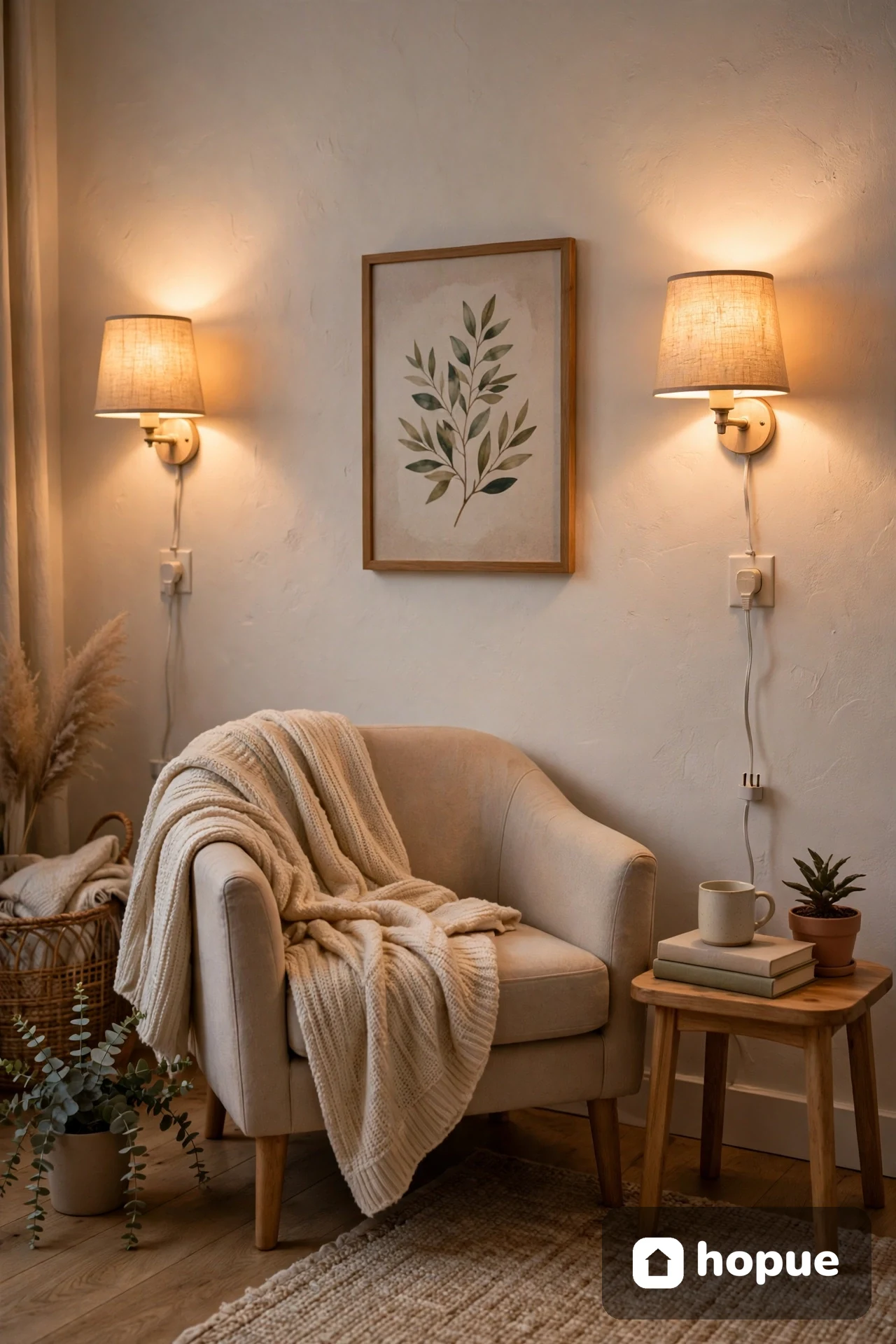
A single swing-arm sconce beside an armchair is the reading corner that finally works. Pull the arm out to read, push it flat when you are done, and the chair never shares floor space with a lamp base. Put it on your dominant reading side, slightly behind the chair, so light falls over your shoulder onto the page instead of into your eyes. Leave a little slack in the cord near the joint so the arm moves without tugging at the plug.
3. Flanking the Sofa Instead of a Floor Lamp
Where a floor lamp keeps getting bumped by the sofa, the dog, or a vacuum cleaner, two sconces flanking the sofa solve the traffic problem. Light comes from the wall, the floor stays clear, and the sofa looks finished. Sit them just outside the sofa’s arms, not above the cushions, so the glow washes down beside you. Keep the shades the same even if the rest of the room mixes styles, so the pair reads as intentional.
4. A Small Light by the Front Door
The entry in most small apartments is a patch of wall, a door, and nowhere to set a lamp. One small sconce near the door changes how the place feels when you walk in at night — no fumbling for keys in the dark. Keep it modest: compact shade, warm bulb, cord routed tight to the skirting board or behind a narrow console table. If your lease says no screws in that wall, this is a good low-risk spot to test an adhesive mount for a week first.
5. A Row Down a Dark Hallway
Hallways are often lit by one ceiling fixture, if at all, so the middle stays bright and both ends go dim. Two or three small sconces spaced down the hall even the light out, and the night walk from bedroom to kitchen stops feeling like a trip through a tunnel. Keep shades small and light low-glare. Run cords down one side only, in matching covers, so the row looks planned. If there is no outlet mid-hall, start from the one you have rather than forcing a cord across a doorway.
6. A Task Sconce Over a Small Desk
A desk in a small apartment is often a table against a wall, with a lamp eating a quarter of the work surface. A sconce just above and slightly to one side gives that surface back. Choose a shade that directs light down, like a small cone or dome, for a pool of light on the work. Clip the cord down the desk leg so it does not dangle where your knee catches it. I once had a cord that would not sit flat until I realized the desk sat a half-inch too far from the wall. Pulling it flush fixed it in seconds.
7. Two Sconces Inside a Gallery Wall
A gallery wall does not have to be pictures only. Two small sconces tucked into the arrangement — one upper left, one lower right, or a pair flanking the largest frame — add light and depth, and make the art look like it belongs in a gallery. Keep sconces smaller than the frames around them, or they will swallow the art. Keep bulbs warm and dimmable if you can, because harsh light makes art look flat. Lay the whole arrangement on the floor first; moving a frame on carpet beats patching a wall.
8. Flanking a Mirror to Double the Glow
A mirror with a sconce on each side is an old trick that still works in a hallway or entry. The mirror bounces light back into the room, so two modest sconces make a narrow space feel brighter. The catch is glare. If you see the bare bulb reflected straight back at you, the sconces are too close to the mirror or the shades are too open. Shades that direct light up and down, or linen that softens the bulb, fix most of that. Wipe the mirror first — dust scatters light and makes everything look dimmer.
9. Low Light Beside the TV
Light beside a TV is about comfort, not brightness. A sconce or two beside the screen, set low and warm, takes the hard edge off watching in a dark room without washing out the picture. Keep sconces behind the plane of the screen, or level with it, never in front. Keep them dim — this is background light, not reading light. A cord dimmer or smart plug set low works well, since you will want it lower for a film than for a casual evening. If light reflects on the screen, adjust the shade angle before moving the sconce.
10. One Statement Sconce Over a Dining Nook
A small dining table tucked into a corner does not need a chandelier. One larger sconce on the wall above and slightly behind the table gives the nook a focal point and enough light to see your food or laptop. Go a little bolder here than in a hallway — a bigger shade, a finish that picks up something else in the room, like brass from a faucet or black from chair legs. Just check clearance where someone stands up. A shade brushed by a head will not stay put long.
11. Soft Light Just Outside the Bathroom Door
Do not put a plug-in sconce inside a wet bathroom zone unless the fixture is rated for it, and most decorative plug-in sconces are not. Put one just outside the bathroom door instead, in the hallway or dressing area, where it lights the approach with no water risk. This is the light for a middle-of-the-night trip without waking yourself up fully: warm, low, on a cord dimmer or smart plug. Keep the cord clipped tight and away from the doorway threshold, so nobody trips on it half-asleep.
12. A Cord Cover That Disappears Into the Wall
The cord is the part most people dread, and a cord cover is the simplest fix. A slim channel sticks to the wall, the cord sits inside, and the run reads as a clean line instead of a dangling wire. Paint the cover the same color as the wall — most are paintable — and from across the room it all but vanishes. Measure before you buy, and buy one length longer than you think you need; joining two pieces mid-wall always shows. Run it straight down. A diagonal run looks like a mistake even when it is the shortest path.
13. When the Cord Becomes Part of the Look
Not every cord needs hiding. A fabric-wrapped cord matching the shade, or a cord held by small brass clips at even intervals, can look intentional — almost like the sconce was drawn onto the wall. This suits rooms with visible texture: brick, wood paneling, a wall of shelves where a straight white cord would stand out more. The trick is deliberateness. A cord that sags looks accidental; one held taut at even intervals, following a line you chose, looks designed. Never let it hang where it can snag on a chair back or bag hook.
14. Linen Shades for a Soft, Forgiving Glow
Linen shades are the forgiving choice. They soften the bulb, spread light evenly, and hide small sins — a slightly crooked mount, a bulb that runs a touch bright, a wall patch that never quite matched. In a small room that softness matters, because hard light shows every flaw. Linen suits almost any style, from rental-white walls to secondhand wood. Keep it clean, since dust shows on light fabric with a bulb behind it. And use the bulb type the fixture specifies — a hotter bulb than the shade is rated for is a risk near bedding or curtains.
15. Rattan and Woven Shades for Texture
If your room feels flat — white walls, plain sofa, a rug that does its job and nothing more — a rattan or woven shade adds texture without clutter. The weave throws a pattern of light and shadow that shifts through the evening, and the natural material warms a room that has felt cold and rented. Woven shades are lighter than they look, which helps with mounting, but they are less forgiving of a bright bulb: light leaks through the gaps, so too strong a bulb throws a busy pattern. Start dimmer than you think you need.
16. A Metal Shade for a Cleaner, Sharper Line
Sometimes a room needs a sharper line, not more softness. A metal shade — matte black, brushed brass, a simple dome or cone — gives a clean outline and directs light with more purpose than fabric. It suits a desk, a kitchen-adjacent nook, or a modern-leaning living room that does not want another soft textile competing with the cushions. Metal shows fingerprints and dust more than linen, so wipe it when you dust. It also gets warm, so give it clearance from curtains and bedding, and let it cool before adjusting it.
17. Glass Shades When You Want the Bulb to Show
A glass shade — clear, seeded, or softly frosted — is for when you like the bulb itself. A vintage-style filament bulb in clear glass becomes part of the decoration, and the light is open and airy rather than pooled. In a small room with low ceilings, that openness keeps the wall from feeling heavy. Frosted glass is the middle ground if clear feels too exposed. Handle the shade with both hands, and fit it last, after the base is secure and the bulb is in. Glass chips most often when someone tries to hold shade, bulb, and screwdriver all at once.
18. The Cord Dimmer That Changes Everything
If your sconce plugs in, a cord dimmer is the cheapest upgrade that makes the biggest difference. A slider on the cord, or a plug-in dimmer box between outlet and sconce, takes light from bright-enough-to-read to barely-there in one motion. No rewiring, no wall switch, no app. Check two things first: that your bulb is dimmable, and that the dimmer is rated for that bulb type. A bulb that flickers or buzzes is telling you the pairing is wrong. A dimmer also tames glare — set light where the room feels lit but the bulb stops demanding attention.
19. A Smart Plug for Lights on a Schedule
A smart plug turns a plug-in sconce into a scheduled light without changing the sconce at all. Set it to come on at sunset and off at bedtime, or on for an hour in the morning so you are not walking into a dark flat after work. For a hallway or entry sconce, that schedule is the difference between a light you remember to use and one that just works. Keep it simple — one schedule you keep beats five clever routines you forget to update. Keep the plug reachable, not buried behind a bookcase, so you can hit the manual button if Wi-Fi drops.
20. Battery Sconces for a Wall With No Outlet Nearby
Some walls have no outlet within a sensible cord run, and no cord cover will fix that gracefully. A battery-powered sconce — adhesive or a couple of small screws, rechargeable or replaceable batteries inside — lights that wall with no cord at all. It suits a closet wall, an awkward reading nook, or a wall where the landlord has said no to new holes. Be honest about trade-offs: battery sconces are usually dimmer, they need charging or new batteries regularly, and they are accent light, not task light. Do not expect one to light a whole desk for evening work.
21. A Thrifted Base With a Brand-New Shade
The budget move that looks most expensive is a thrifted base with a new shade. Charity shops, estate sales, and secondhand listings are full of solid plug-in sconces whose shades are dated, dusty, or missing. The base costs money new; the shade dates fastest. Check wiring before you fall in love with a find: frayed cords, cracked plugs, loose sockets, any smell of burning. If anything looks damaged, walk away — a bargain is not a bargain if the cord is unsafe. If wiring is sound, clean the base, fit a new shade, use a bulb the fixture specifies.
22. Light as a Room Divider in a Studio
In a studio, light can mark where one zone ends and another begins. A sconce on the wall between sleeping and living areas, or where the desk zone starts, draws a boundary without a screen or bookshelf eating floor space. Your eye reads the lit wall as a division, even though nothing blocks the room. Use a different warmth or brightness on each side if you can — warmer and dimmer over the bed, slightly brighter over work. Keep cords on the wall side, not trailing across the floor where zones meet.
23. Rescue for the Corner That Always Looked Dark
Every small apartment has one: the corner that stays dark no matter how many lamps you add, because the ceiling light does not reach it and a floor lamp would block the walkway. A single sconce in that corner, angled slightly into the room, rescues it. The corner stops being dead space and becomes a place — a chair fits there now, a plant thrives there, books look like they belong. Choose a shade that throws light both up and down. The upward wash lifts the ceiling; the downward wash lights whatever sits beneath it.
24. A Sconce Headboard for a Bed With No Headboard
No headboard, no problem — two sconces and a bit of intention can stand in for one. Mount a pair above the bed, spaced a little wider than the pillows, with art, a textile, or small frames between them. The eye reads the whole arrangement as a headboard, and you get reading light thrown in. Clearance matters most here: sconces sit above a bed, near pillows and bedding. Keep fabric and throws well clear of shades, especially if they run warm, and use the bulb type the fixture specifies. Sit up and reach for the switch before calling it done.
25. A Flattering Light for Video Calls
If you work from home, your video-call background is a wall, and light on your face is whatever the ceiling fixture throws down — usually harsh from above, shadowy under the eyes. A sconce on the wall behind your screen, or facing you at eye level, fills in that light softly. Warm light flatters most faces on camera, and a dimmer lets you tune it so the screen is not washed out. Keep the sconce out of frame if you want it invisible, or let a pretty shade sit in frame deliberately. Test it on a real call with a friend first.
26. A Gentle Wash of Light for Plants
Plants in a corner away from the window get forgotten, and a sconce nearby brings them back into the room in the evening. A warm, low sconce washing down shelves or a tall plant makes greenery part of the evening room, not just a daytime feature. The leaf shadows on the wall are half the pleasure. Say it plainly, though: this is decorative light, not grow light, and it will not replace sunlight for a plant that needs it. Keep water and electrics apart — switch off before misting or watering nearby, and never let a cord sit in a saucer or puddle.
27. Light Tucked Beside a Bookshelf
A bookshelf against a wall with no light of its own goes dark by evening, and finding a book means turning on the main light. A narrow sconce on the wall just beside the bookshelf lights the spines without a lamp on top of the unit. Keep the shade small and light warm, angled to wash across spines rather than glare into the room. If the unit is freestanding and you plan to take it with you, mounting on the wall beside it is safer than drilling into the unit. A clip-on cord run down its side keeps everything tidy and removable.
28. Warm Light Low, Cool Light Only Where You Work
Small rooms punish the wrong bulb temperature more than big rooms do, because harsh light has nowhere to hide. The rule that has served me best is simple: warm light low and near where you relax — bedside, sofa, reading chair — and cooler, clearer light only where you need detail, like a desk or dressing area. That does not mean a drawer full of bulbs. It means choosing on purpose, room by room, and reading the bulb description before buying. A warm bulb at a desk makes work feel sleepy; a cool bulb beside a bed makes winding down feel like a shift starting.
29. The Setup You Can Take Down in an Afternoon
The last idea makes all the others possible in a rental: design the setup to come down cleanly. Keep original hardware and instructions in a labeled bag, photograph each sconce in place before removal so you remember the cord route, and choose mounts you can reverse — adhesive strips rated for the weight, or anchors you know how to patch. At move-out, remove the sconce, pull the anchor or strip as its instructions say, fill small holes, and touch up paint if your landlord expects it. I have done this in an afternoon for a whole flat, and the wall looked like nothing had ever been there.
A plug-in sconce will not fix a flat with no outlets, a landlord who says no to every wall mount, or a room that needs a full rewire. What it will do, chosen carefully and mounted honestly, is give a small rented room light that makes you want to stay in it in the evening — warm light beside the bed, a clear pool over the desk, a soft row down the hall. Start with one wall, one outlet, one sconce you can live with. Live with it for a week. Then decide where the second one goes.
Frequently Asked Questions
Can I mount a plug-in sconce without hardwiring or drilling?
Yes — that is the whole point of a plug-in sconce. It plugs into a standard outlet, so there is no hardwiring or rewiring. For mounting, many renters use adhesive strips or hooks rated for the sconce’s weight, and some use small screws where the lease allows them. Check your lease first, test any adhesive mount in a discreet spot, follow the weight rating exactly, and use the right anchor for hollow walls. If the sconce feels loose or starts to tilt, take it down and rethink the mount before it falls.
How do I hide the cord so it does not look messy?
Start with the shortest sensible route: straight down to the outlet, or down to the skirting board and along it. A paintable cord cover makes that run look like a clean line, and small clips keep a bare cord taut behind furniture. Routing behind a bedside table, sofa, or desk hides most of it for free. Never run a cord under a rug where it can overheat or get damaged unseen, and replace any cord that is frayed or cracked. If a cord must cross a walkway, reroute it — a cord underfoot is a trip risk, not a styling choice.
Do I need my landlord’s permission, and what happens at move-out?
It depends on your lease, so read the clause about walls, holes, and alterations before mounting anything. Many leases allow small screw holes you fill at move-out; others allow adhesive mounts only; some require written permission beyond picture hooks. When in doubt, ask in writing and keep the reply. At move-out, remove each sconce, remove anchors or strips as instructed, fill small holes, and touch up paint if needed. Photographing walls before mounting gives a useful record of how they looked when you moved in.
Which bulb should I use, and can I dim a plug-in sconce?
Use the bulb type and base the fixture specifies, and check the shade’s heat rating before choosing a brighter bulb. Warm bulbs suit bedrooms, living rooms, and reading corners; a clearer, cooler bulb suits a desk or dressing area where you need detail. Most plug-in sconces dim with a cord dimmer or plug-in dimmer, as long as the bulb is dimmable and the dimmer is rated for that bulb type. If a bulb flickers or buzzes, try a different dimmable bulb rather than living with the flicker. Battery sconces suit walls with no nearby outlet, but expect softer light and regular charging, and do not rely on one as your only task light.