29 Floor Lamp Styling Ideas for a Small Apartment
Most small apartments have the same lighting problem. One harsh ceiling light, if you have one at all, and darkness in every corner that actually matters. My first rental had a single flush-mount that made everything look washed out, and a bedroom with no ceiling fixture whatsoever. A floor lamp fixed both rooms, and I never had to ask my landlord for anything.
Floor lamp styling in a small apartment is less about buying the prettiest lamp and more about where you put it, what bulb you use, and how it works with furniture you already own. The ideas below cover lamp types, placement, shade swaps, cords, roommates, pets, and moving day. Take what fits your rooms and skip the rest.
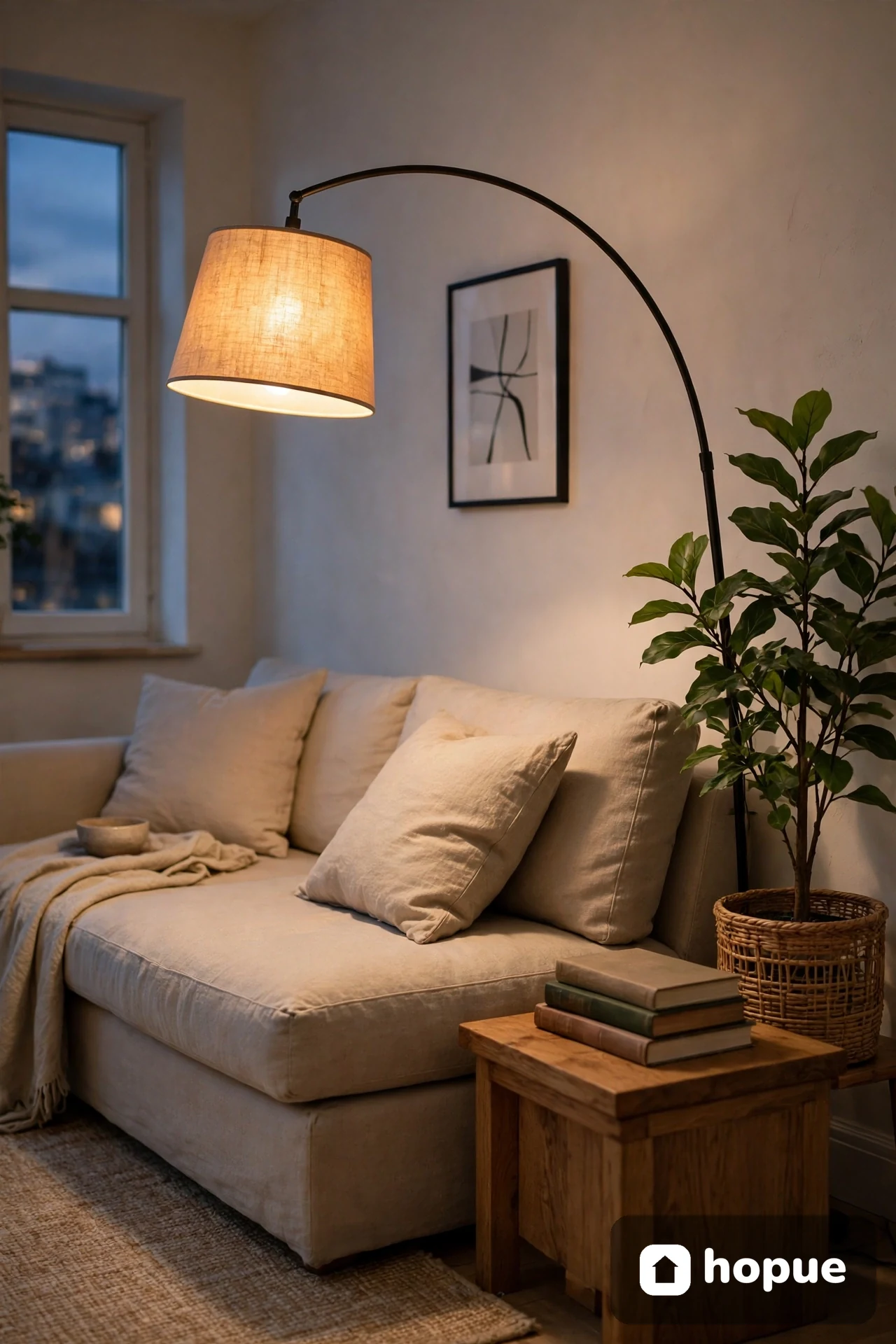
1. Tuck an Arc Lamp Over the Sofa Arm
An arc lamp does the work of an overhead light without touching the ceiling. The curved arm reaches over the sofa, so light lands where you sit instead of pooling in the middle of the floor.
I borrowed one for a winter and nudged the base a few inches at a time until the shade hung just past the armrest. It lit my book and my roommate’s laptop at once. Just make sure the base is heavy enough that the curve does not tip when someone brushes past on the way to the kitchen.
2. Use a Slim Column Lamp in a Dead Corner
Every small apartment has a corner that collects a laundry basket and nothing else. A slim column lamp can turn that dead spot into something useful.
The narrow base slides in beside a bookshelf or dresser without eating the floor space you need for walking. Put the shade close to the wall so the lamp reads as part of the room. Parked in the middle of the corner, a few inches out, it will always look like it is waiting to be moved somewhere better.
3. Put a Tripod Lamp Beside the Reading Chair
Three legs sounds like a bad idea in a tight room. Beside a chair, it works. The legs spread the weight out, so the lamp stays put, and you can still see floor underneath it, which matters when the living room doubles as a walkway.
The shade should sit a little above your shoulder when you read. Light falls on the pages then, not in your eyes. A shade that points down beats one that throws light sideways for this spot.
4. Let a Torchiere Bounce Light Off the Ceiling
Torchieres point up. Light hits the ceiling and spreads back down, soft and even, with no bright spot staring back at you. In a room with no overhead fixture, that bounce is the closest thing to having one.
I used one in a studio where the only other light was a kitchen strip that buzzed. The room felt taller, and the glare on the TV went away. It needs a plain, light ceiling to bounce off. A dark ceiling will swallow the glow, so save this lamp for rooms where the ceiling can help.
5. Try a Pharmacy Lamp for a Desk-Side Nook
This is the lamp with the long adjustable arm and the small tilting shade. Pull it close when you work, push it back when you are done, and the base never moves.
My desk faced a wall in a room I shared, and the narrow beam kept late-night work from lighting up my roommate’s side. That is the whole point of this lamp. If you want glow for the whole room, it will disappoint you. For one chair, one desk, one reader, it is hard to beat.
6. Style a Tree Lamp With Three Shades
A tree lamp branches into several lights off one pole, each with its own small shade. Point one toward the sofa, one toward a dark corner, one at the wall behind the TV.
That flexibility matters in a room that has to be a living room, an office, and a dining room by turns. I kept one in a long, narrow railroad apartment, and the third shade washing the far wall stopped the room feeling like a tunnel. Get one with separate switches. All three on at once, every night, gets old fast.
7. Warm Up a Rattan Lamp in a Neutral Room
Rattan brings texture that a metal pole never will. In a room of white walls, a gray sofa, and a tired wood floor, a woven shade adds warmth without a color you have to match to anything else.
At night the light filters through the weave and throws a soft pattern on the wall. Mine came from a thrift store with a wobbly base, fixed with a felt pad underneath. It sat beside a linen chair and made that corner feel finished, even while the rest of the room was still mostly boxes.
8. Soften a Paper Lantern Lamp in the Bedroom
A paper floor lamp glows instead of shining. The shade diffuses the bulb until the whole lamp becomes the light source, and a bedroom feels calm instead of lit up like a hallway.
Keep it on the far side of the bed, away from the door, so you can read and switch it off without crossing a cold floor. Paper dents and tears easily, so this lamp belongs where nobody brushes past it. Keep it clear of heaters, and out of the path to the bathroom at night.
9. Anchor the Sofa With a Black Metal Lamp
A black metal lamp does not try to be the star of the room. It frames the sofa the way a dark frame frames a print. If your sofa is light and your rug is busy, a simple black pole and a plain drum shade give your eye somewhere to rest.
I swapped a patterned shade for plain linen on the same black base, and the seating area looked calmer overnight. One strong dark line beside the sofa is enough. A matching lamp on the other side only works if the room is wide enough to carry the pair without feeling boxed in.
10. Pair a Floor Lamp With a Tall Plant
A floor lamp beside a tall plant looks planned even when it was not. The leaves soften the straight line of the pole, and light coming through the foliage at night makes the corner feel alive.
My monstera sat next to a slim brass lamp for a year, and guests always assumed I had styled it on purpose. I had just run out of other places to put the plant. Leave a hand’s width of air between shade and leaves. Plants grow toward light, and a leaf pressed against a hot bulb will brown fast.
11. Hang Art Low and Light It From Beside
Art hung too high is a small-apartment habit, usually because nobody wants to put holes in the wall. Hang the piece lower, at the height you look at it from the sofa, and set a floor lamp just to one side.
Sideways light brings out texture in a print or a woven hanging in a way ceiling light never does. Command strips held my framed poster for a full lease, and the lamp beside it made the poster look like it belonged there. Angle the shade a touch toward the wall, not straight into the room.
12. Swap the Shade, Keep the Base
You do not need a new lamp to change how a room looks. A new shade costs far less and takes five minutes to fit. A drum shade reads modern. A tapered shade reads a little more classic. Linen softens the light, while a darker shade sends more of it up and down instead of out through the sides.
I kept one brushed-metal base through three apartments and changed the shade each time to match the new rug. Bring the old shade when you shop, or check the fitting at home first. A shade that wobbles will annoy you every single day.
13. Go Warm in the Living Room, Cooler by the Desk
Bulb color changes how a room feels more than the lamp itself does. Warm light makes a living room feel like evening, even at noon on a gray day. Near a desk, a cooler, clearer light helps you stay alert and see what you are doing.
I put the same warm bulbs everywhere once and kept rereading the same email. Now the lamp by the sofa glows warm and the one by my desk stays crisp. Buy one of each and test them at night before you stock up. The box never tells the whole story.
14. Add a Dimmer Plug When the Lamp Has No Dimmer
Most cheap floor lamps have one setting: on, at full blast. A plug-in dimmer sits between the lamp and the outlet and turns that one setting into a range, with a slider or a remote.
Movie night, the lamp goes low. A friend comes over to look at a lease, it goes up. My old lamp had a pull chain that clicked loud enough to wake a roommate, and the remote meant I never touched the chain after dark. Check that your bulb can dim first. A bulb that cannot dim will flicker, and flicker gets old in about a minute.
15. Hide the Cord With a Flat Cover and a Rug
A cord snaking across the floor is ugly, and in a small apartment it is a trip hazard too. Run it tight along the baseboard, cover the visible stretch with a flat cord cover that matches the floor, and let the rug do the rest.
I taped a cord down with packing tape once, in a rush before guests arrived. The tape left a sticky line that outlasted the lease. The flat cover cost a few dollars and came off clean when I moved. Better yet, move the lamp closer to the outlet instead of running a cord across a walkway.
16. Layer a Floor Lamp With a Small Table Lamp
One light source flattens a room. Two, at different heights, give it depth. A floor lamp in the corner plus a small table lamp on a side table creates pools of light instead of one flat wash.
With the overhead off and the two lamps on low, a living room that once made everyone look tired felt like a place to sit in. Keep both lamps in the same warm family of light so they do not fight each other. Mismatched bulb colors side by side are distracting in a way that is hard to name until you fix it.
17. Make a Reading Nook With a Chair, Lamp, and Basket
A reading nook does not need a bay window or a built-in bench. It needs a chair you like sitting in, a lamp that lights the pages, and somewhere to put the book down.
I carved one out of the end of a hallway by turning an armchair at an angle, tucking a lamp behind it, and dropping a basket beside it for books and a blanket. The angle mattered. Facing the wall, it felt like a corner I had been sent to. Angled toward the room, it felt like a choice.
18. Light a Dark Hallway Without Wiring
Hallways in rentals are often dark because nobody wants to pay an electrician for a space you only walk through. A slim floor lamp at the end of the hall solves it with zero wiring.
Mine sat at the end of a hallway with no fixture at all, on a timer plug, so it came on before I got home from work. No more fumbling for keys in the dark. Choose a narrow base above all else here. A lamp that sticks out into the path will get kicked, and in a narrow hall it has nowhere to fall but over.
19. Place a Lamp by the Balcony Door for Evening Glow
A lamp beside a balcony door pulls double duty. Inside, it lights the seating area. After dark, the glass reflects the glow back, and the room feels bigger than it is.
My second-floor sliding door faced a parking lot, which is not exactly a view. In the evening, though, the lamp glow on the glass made the whole wall feel softer. Set it a little back from the door track so curtains do not catch on the base. If the door gets hard afternoon sun, pick a shade that will not fade unevenly in one season.
20. Use a Smart Plug So Roommates Can Share Control
Sharing a living room means sharing the lamp, and someone always leaves it on. A smart plug lets everyone turn it on and off from a phone, set a schedule, or use a speaker if you have one.
My roommate and I split the cost of one plug, and the arguments about who left the light on stopped overnight. It helped on late nights too. The lamp could already be on, low, instead of walking into a dark apartment. No rewiring, no landlord permission, and you take the plug with you when the lease ends.
21. Let One Statement Lamp Be the Focal Point
Some rooms need one bold thing and a lot of quiet around it. A sculptural lamp, with an unusual shape, a colored shade, or a mixed-metal finish, can be that thing. Let it stand alone in a corner with nothing competing beside it.
I bought a lamp with a curved walnut stem at a flea market and put it where a side table used to be. Everything else stayed plain, and people noticed the lamp first every time. Do not crowd it. Add a plant, a stack of books, and a basket to the same corner, and the statement disappears.
22. Match the Finish to Your Hardware, Not Your Furniture
Matching a lamp to your sofa is a trap. Sofas get covered, moved, and replaced. Hardware stays. Look at your door handles, kitchen pulls, and curtain rod, and pick a lamp finish in the same family.
Brass handles, brass or warm-toned lamp. Black hardware, black or dark bronze lamp. My apartment had brushed nickel handles everywhere, and a nickel lamp base tied the living room to the kitchen without me buying anything else. Nobody will point at it and say it matches. That is why it works.
23. Style a Tiny Studio With One Lamp That Moves
In a true studio, the same floor is a bedroom at night and a living room by day. One lamp that moves easily earns its keep better than three fixed ones. Pick a light base, a shade that is not precious, and a cord long enough to reach two outlets.
I dragged my studio lamp from beside the sofa in the morning to beside the bed at night for a year. Ten seconds, and it looked fine in both spots because it was simple: plain pole, white shade. A base too heavy to lift with one hand will not move, and a lamp that never moves sits in the wrong place half the time.
24. Create a Work Zone in a Room With No Overhead Light
Working from a corner of a bedroom is common for renters, and the lighting is usually an afterthought. A floor lamp behind the desk, aimed so light falls on the work surface without hitting the screen, changes how long you can work without a headache.
I set one up behind my desk, slightly to the left, and the glare on my laptop vanished. The lamp also marked the edge of the work zone. On, I was working. Off, the corner went back to being part of the bedroom. Keep the lamp behind you, never between you and the screen.
25. Swap Shades for the Seasons
You do not need to redecorate four times a year. Swap the shade. Light linen feels right in summer, when days are long and the room is already bright. A deeper-toned shade in fall and winter makes the same lamp feel warmer and more closed-in, in a good way.
I keep two shades for one base in the top of a closet, wrapped in an old pillowcase so they do not dent. The swap takes a minute. It is the only seasonal change I make that does not involve hauling a box out of storage, and a dented shade shows every flaw once the bulb is on.
26. Thrift the Base and Buy the Shade New
Lamp bases are sturdy, simple things, and thrift stores are full of them for a few dollars. Shades collect dust, dents, and smells that cleaning never quite fixes. Buy the base secondhand and the shade new, and you get a lamp that looks fresh for a fraction of the price.
I found a solid brass base at a charity shop, wiped it down, and checked the cord for cracks before plugging it in. A new linen shade finished it. Check the socket and cord carefully on any used lamp. If the cord is frayed or the socket feels loose, walk away, no matter how good the base looks.
27. Keep It Steady With Kids and Pets Around
A floor lamp and a toddler, or a floor lamp and a large dog with a wagging tail, are a familiar collision. Stability matters more than style here. A wide, heavy base, a shade too high for little hands to grab easily, and a cord run tight to the wall will prevent most accidents.
My sister’s cat knocked over a tripod lamp twice before she swapped it for a column lamp with a flat, heavy base tucked behind the sofa. The cat still rubs against it. It does not move now. Nudge any lamp with your foot before you commit to the spot — if it rocks, it is not the lamp for a busy house.
28. Pick a Lamp You Can Carry on Moving Day
Renters move. A floor lamp that comes apart into two or three pieces, or one light enough to carry in one hand along with a box, will survive more moves than a tall, awkward one-piece lamp.
I carried a heavy arc lamp down three flights of stairs in the rain once. It survived, barely, and I swore off heavy bases after that. Look for a lamp that unscrews at the middle, or a base you can detach, and wrap the shade separately in a towel. Shades dent in moving boxes, and you will notice the dent every evening after the move.
29. Style the Entry With a Lamp by the Door
The entry in a small apartment is often just a patch of floor by the front door, not a real foyer. A slim floor lamp there lights the spot where you drop keys and check your bag, and it makes the first thing you see when you walk in feel welcoming instead of bare.
I put a narrow lamp beside a small bench in an entry barely wider than the door itself, on a timer so it was on when I got home. Guests noticed it before anything else. The cord belongs against the wall here most of all. This is where bags, coats, and shoes all compete for the same floor.
The best floor lamp for a small apartment is rarely the most expensive one. It is the one that fits the corner you actually have, lights the chair you actually sit in, and survives the lease, the roommates, and the move. Start with one lamp in the room you spend the most time in, live with it for a week, and then decide if the next room needs one too. A room that glows in the right places feels bigger, calmer, and more like yours, even when the walls are not.
Frequently Asked Questions
Do I need permission from my landlord to use a floor lamp?
No, in almost every rental a floor lamp needs no permission at all. It plugs into a regular outlet, stands on the floor, and leaves no marks when you move it. You only need to check your lease if you plan to hardwire anything, screw a fixture into the ceiling, or run a cord in a way that damages trim. A standard plug-in floor lamp is furniture, not a modification, so you can use it and take it with you when you leave.
What kind of floor lamp is best for a room with no ceiling light?
A torchiere or a tree lamp usually works best, because both spread light upward and outward instead of aiming it at one spot. A torchiere bounces light off the ceiling and fills the whole room, while a tree lamp lets you aim separate lights at the sofa, a corner, and a wall. Either one will make a room without an overhead fixture feel evenly lit. A single narrow reading lamp on its own will leave the rest of the space in shadow.
How do I keep a floor lamp from tipping over in a small apartment?
Pick a heavy, wide base, tuck the lamp behind or beside furniture so it is not standing alone in a walkway, and run the cord tight along the wall so nobody catches it with a foot. If you have kids or pets, nudge the base with your foot before you commit to the spot. A lamp that rocks or slides easily will only get worse once it is bumped daily. Column lamps with flat bases tend to stay put better than tripods in tight, high-traffic spots.
Can I use a floor lamp as my only light for working from home?
You can, but placement matters more than brightness. Put the lamp behind or beside your desk so the light falls on your work surface without shining straight into your eyes or onto your screen. A pharmacy lamp or an adjustable tree lamp works well here because you can aim the light where you need it. If your eyes feel tired after an hour, move the lamp a little farther back and switch to a cooler, clearer bulb for work hours.
Are floor lamps safe to leave on a timer when I am out?
A floor lamp on a timer plug is generally safe if the lamp is in good condition, the bulb is the right type for the socket, and the shade is clear of curtains, bedding, and anything flammable. Check the cord for cracks or fraying, keep the shade away from fabric, and use LED bulbs, which run much cooler than older bulbs. Do not leave a damaged lamp, a lamp with a loose socket, or a paper shade pressed against bedding on a timer. When in doubt, switch the lamp off and test the timer while you are home first.