29 Freestanding Headboard Ideas for a Small Bedroom
My first rental bed had no headboard at all. The pillows slid down the gap every night, the wall got scuffed, and sitting up to read meant a cold wall against my back. I wanted something that looked finished, but drilling was out of the question, and I knew I would be hauling everything up two flights of stairs again in a year. A freestanding headboard for a small bedroom fixes that exact problem, because it stands on the floor or bolts to the bed itself instead of going into the wall.
This list sticks to one rule: every freestanding headboard small bedroom idea here stands on its own, with no screws in plaster and no landlord conversation afterward. Some wedge tight between the mattress and the wall. Some lean. Some attach to the bed frame you already own. All of them can leave with you on moving day, and most cost far less than a whole new bed.
1. The Padded Panel That Wedges Behind the Bed
Start with the simplest version. A flat upholstered panel, a little wider than your mattress, slides down between the bed and the wall and stays put because the bed pushes it back. Mine wobbled the first week until I shoved the frame hard against the wall and stopped letting the mattress drift. Pick a firm foam core with a linen or cotton cover. A floppy panel folds in half the first time you lean on it, and then it is just an expensive pillow.
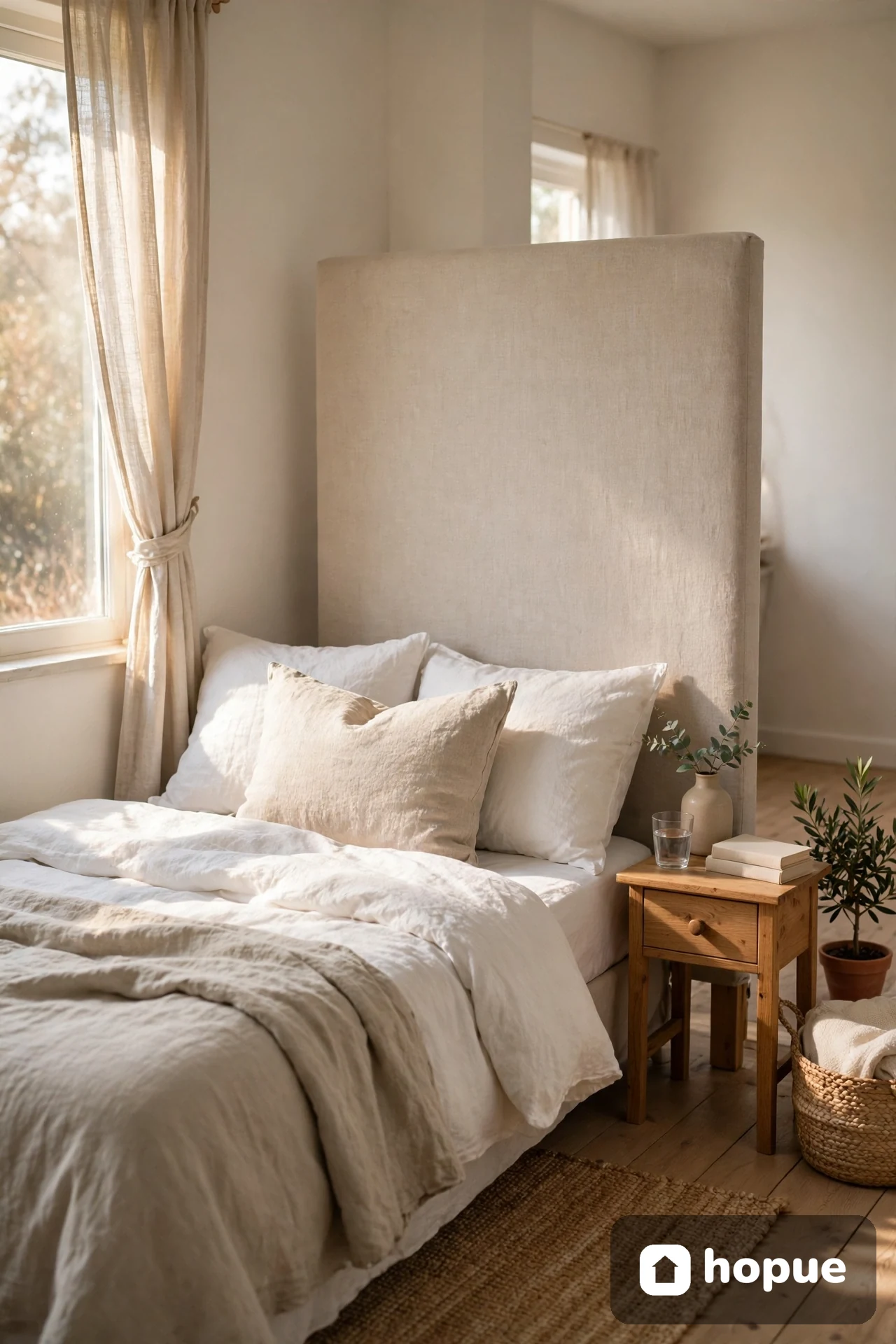
2. A Tall Linen Panel for Sitting Up in Bed
If you read in bed, you need height. A tall linen panel rises well above the pillows, so your shoulders rest against fabric instead of bare wall. Cream and soft gray hide dust better than stark white. Solid legs or a wide base matter most here, not a panel that only balances on the mattress edge. Keep the color close to the wall color in a narrow room, and the panel almost disappears while the bed finally looks intentional.
3. A Leaning Wood Slat Panel
Wood slats give a bedroom a warm, cabin-like feel without a single wall anchor. The panel leans at a slight angle, feet on the floor, top resting lightly against the wall. That lean is doing the work, so do not push the bed away and leave it floating. I learned that during a midnight stretch that sent the whole thing sliding sideways with a loud scrape. Choose slats with small gaps for air and light, and a finish you can wipe clean with a damp cloth.
4. A Rattan and Cane Screen Behind the Pillows
Rattan looks light, which matters when the room itself is tight. A cane panel lets a little wall color show through, so the headboard does not turn into a dark block behind your head. It is also lighter to carry than solid wood, a real plus if you live upstairs and move alone. Check the back before you buy, because rough cane edges snag pillowcases. A smooth frame and tight weaving matter more than a fancy shape. Pair it with crisp cotton sheets and stop there.
5. A Metal Frame That Bolts to Your Bed Frame
This is the steadiest option for restless sleepers. Instead of touching the wall at all, the headboard bolts to the bed frame itself, using the holes and brackets most frames already have. My bed used to creep forward a little each night. Once headboard and frame moved as one piece, the gap closed for good, and nothing fell down the back anymore. Black metal suits almost any bedding and does not show every mark the way pale fabric does. Check that the brackets line up before you buy.
6. A Tufted Velvet Panel for a Small Luxe Moment
Velvet sounds fancy, but in a rental it is often the cheapest way to make a plain bed look deliberate. A tufted panel in deep green, navy, or warm rust turns a basic frame and white sheets into something that looks styled. The catch is upkeep. Velvet shows pressure marks where pillows press, and pet hair clings to it, so keep a lint roller in the nightstand drawer. A sturdy back and floor-standing legs are non-negotiable here, not a thin board meant to hang, and let the bedding stay simple so the texture does the talking.
7. A Bookcase Headboard You Can Actually Use
A low bookcase standing behind the bed works as a headboard and a nightstand in one. That matters when there is no room for a table on one side. Put the book you are actually reading on top, a charger in a cubby, and nothing breakable at pillow height. I knocked a glass off mine once at 2 a.m. Lesson learned, the hard way. Keep the unit shallow, push it flat to the wall, and let the bed hold it in place. Empty the shelves before you carry it upstairs.
8. A Storage Headboard With Cubbies and Doors
Think of this as the bookcase idea, grown up. Cubbies with doors hide chargers, medicine, spare pillowcases, and all the small stuff that clutters a tiny bedroom. The doors matter. Open shelves at head height collect dust and look messy fast. A floor-standing unit with a solid back stays stable, and the weight inside actually helps it stay put. Leave the top clear except for one lamp. If it starts to squeak when you shift in bed, it has drifted from the wall. Shove it back.
9. A Freestanding Curtain Panel on a Floor Stand
You do not need a curtain rod in the wall to get soft fabric behind the bed. A freestanding garment-style stand holds a curtain panel at headboard height, and the fabric falls to the floor on either side of the bed. It softens a hard wall and hides scuffs and old paint patches. Use a heavy fabric so it hangs straight and does not billow every time you open the bedroom door. Tie the bottom corners loosely behind the bed legs if the panel keeps swinging. Washable fabric wins here, every time.
10. A Folding Screen as a Headboard
A three-panel folding screen is a headboard, a room divider, and a moving-day hero all at once. Fold it flat, carry it under one arm, unfold it behind the bed. The slight zigzag shape makes it stable on its own feet, which is why it works without any fixing. In a studio, angle one panel slightly forward and you get a hint of separation between bed and living space. Avoid paper screens if you lean back hard. Wood, rattan, or fabric-covered panels take daily pressure far better and do not tear when a pillow corner catches them.
11. Oversized Floor Cushions Propped Behind Pillows
No panel, no frame, just big cushions. Two or three oversized floor cushions, propped upright between the pillows and the wall, make a soft headboard you can rearrange in seconds. Best pick if you change your mind a lot, or if your lease is short and you do not want another bulky thing to move. Honest downside: cushions slump. Fluff them every morning, and pick covers with zippers so you can wash them. One plain cushion plus one patterned one looks less like a pile of bedding that escaped.
12. A Leaning Pegboard-Free Board With Hooks on a Ledge
Skip the pegboard that needs wall screws. Take a plain leaning board with a shallow ledge at the bottom and a couple of removable hooks on the front for a cap, headphones, or a sleep mask. The ledge holds a book and a glass of water at arm’s reach. It only stays put if the bottom sits flat and the bed wedges it in, so test it before you trust it. Lean back firmly a few times, then check for sliding. Paint it the same color as your bedding for a calm look, or leave the wood raw.
13. Reclaimed Wood Planks Leaned as One Panel
Old barn wood or salvaged fence boards, joined into one leaning panel, give a bedroom instant character. No two panels look alike, which is the whole point. Sand it well. Really well. Splinters at head height ruin the romance fast, and rough wood snags sheets. Seal it with a clear matte finish so you can dust it without raising the grain. Reclaimed wood is heavy, so carry it with help and wedge it tight. Simple linen bedding and a plain rug let the wood stay the star.
14. A Painted MDF Arch Panel That Leans
An arch shape softens a boxy small bedroom in a way a rectangle never does. A painted plywood or MDF panel, cut into an arch and leaned behind the bed, costs little and looks custom. Paint it a color pulled from your bedding — deep sage, dusty blue, warm clay — and leave the wall around it plain. The panel needs a flat bottom and a bed pushed snug against it, or it will walk sideways over a few nights. Add felt pads where it meets the floor so it does not scrape rental floors.
15. A Fabric-Wrapped Foam Panel You Make Without Drilling
This is the classic no-drill DIY, and it still works. Wrap thick foam over a plywood base, pull fabric tight over the front, and staple it on the back. Add short legs or a wide base so it stands on the floor behind the bed. The trick is pulling the fabric evenly, because wrinkles show, especially with plain fabric. Ask someone to hold the board while you staple, starting in the middle of each side. Pick a washable, mid-weight fabric. Thin fabric shows every foam bump. Very heavy fabric is a fight to pull tight by hand.
16. An Arch-Shaped Upholstered Headboard That Stands Alone
Combine the arch shape with soft upholstery and you get a panel that feels gentle and grown-up at once. The curved top breaks up the straight lines of a small room, and the padding makes leaning back comfortable for reading before sleep. Buy the freestanding version with legs that reach the floor, not a wall-hung style sold as a headboard. The fabric should be tight, with no loose folds at the curve. That curve is where cheap work shows. A solid color works best. Save pattern for the duvet cover.
17. A Low-Profile Panel for a Low Platform Bed
High headboards can swallow a low platform bed and make the ceiling feel lower than it is. A low-profile panel, rising just above the pillows, keeps the proportions right. You still get a finished edge behind the bed and something soft to lean on, without a tall board looming over you. It also leaves wall space above for one framed print. Go slightly wider than the bed so the low height still reads intentional. Narrower than the mattress, and it looks like a mistake, not a choice.
18. A Tall Statement Panel That Reaches Toward the Ceiling
A tall panel can make a small bedroom feel taller, not smaller, if everything else stays quiet. One tall, plain panel in a dark wood tone or deep fabric color draws the eye up and gives the bed a clear anchor. Skip busy patterns here. The height is the statement. Make sure the base is wide and the panel cannot tip forward if someone leans hard, and wedge it with the bed. Do not balance anything heavy on top. Tall panel, pale bedding, low lamp: calm, hotel-like, still rental-friendly.
19. Two Twin Panels for a Shared Bed
Couples rarely agree on pillow height, reading habits, or how far to lean back. Two separate twin-size panels, pushed together behind one bed, let each side sit at its own angle. One partner sits up with a book while the other lies flat, and neither panel drags the other along. Line them up carefully at the center seam so the join does not show as a crooked gap. Matching fabric keeps it looking like one headboard. Different fabrics can work, but only if the colors are close, or the bed looks split down the middle.
20. A Two-Piece DIY Build With Legs and a Cross Brace
Like building things? This is a solid weekend project. Two upright legs, a cross brace near the bottom, and a front panel of plywood, slats, or fabric-wrapped board, all screwed together at the back where nobody sees the joints. The brace stops the legs from splaying, which is what makes most homemade leaning boards wobble. Test it on the floor before you slide it behind the bed. Push it, lean on it, listen for creaks. Fix a loose joint now, not at midnight. Paint the back too, since a gap beside the bed will show it.
21. A Thrifted Door Leaned Behind the Bed
An old solid door, cleaned and sanded, leaned behind the bed is one of the cheapest statement headboards around. A door with panels or glass panes works best, and check it for loose hardware before bringing it inside. Remove the handle or tape it down so it does not rattle. Doors are heavy and awkward on stairs, so check your stairwell turn and bring help. I carried one alone once. Never again. Wedge it tight with the bed, and keep bedding simple. The door already has enough detail without a busy quilt fighting it.
22. A Budget Flat-Pack Freestanding Buy
Not every good headboard has to be handmade or thrifted. Budget flat-pack panels, sold as freestanding, often come with legs, a simple fabric or faux-leather front, and clear instructions. The win is speed and a clean look on day one. The risk is wobble from loose fittings. Tighten every bolt during assembly, then tighten them again after a week of use. Wood frames loosen as they settle, and that first squeak is your warning. Pick a plain style in a neutral color, and spend the money you saved on decent pillows.
23. A Headboard With Clip-On Reading Lights Built In
A headboard that holds its own lights solves the no-nightstand problem and the no-wall-lights problem at once. A panel with a top ledge or sturdy sides works best, somewhere clip-on lights can grip without damaging the surface. Battery lights avoid cords snaking across the floor, but keep spare batteries handy. Plug-in clip lights are brighter, so run the cord down the back of the panel and behind the bed leg. Test the clamp on a hidden spot first. A light that slides down at night is annoying. One that marks the fabric is worse.
24. A Neutral Panel Styled With Layered Bedding
Sometimes the headboard is not the star. A plain neutral panel in beige, gray, or soft white lets layered bedding do the work: a textured duvet, a folded throw at the foot, pillows in two or three close tones. Smart move if you like changing bedding with the seasons. Swap the throw and pillowcases, and the whole bed feels new without touching the headboard. Keep the panel fabric matte, not shiny, so it does not compete with the bedding. And keep layers tidy at the head end, or pillows will push the throw into a lump by morning.
25. A Narrow Panel That Leaves Room for Nightstands
In a truly tight bedroom, a headboard only as wide as the bed, or a touch narrower, leaves precious space for a nightstand, a charger, and a glass of water. Wider panels look grand in pictures and eat the wall in real rooms. Measure the wall you have, not the wall you wish you had, and leave a gap on at least one side for getting in and out. A slim panel with a simple shape, no wide wings or thick posts, keeps the walkway clear. It also makes the bed easier to make.
26. A Divider Headboard for a Shared Bedroom
Roommates sharing a bedroom need a boundary that is not a fight. A freestanding divider headboard, standing a little wider and taller than the bed, marks where one sleeping area ends and the other begins. It blocks a little light and a little sound, and it gives each person a backrest of their own. Keep it stable and gap-free at the floor, or it becomes a tripping hazard in the dark. Both people should agree on the height before it goes up. A headboard that only suits one roommate will get moved, and moved back, every week.
27. A Leaning Panel With a Picture Ledge on Top
A leaning panel with a shallow ledge along the top gives you a place for one framed print, a small plant, or a paperback without drilling a shelf. Keep the load light. One frame, not heavy books, or the top gets top-heavy and the panel leans wrong. Use museum putty under the frame so a bump in the night does not send it sliding. This works best when the ledge is part of the build, wood or upholstered. A flimsy add-on ledge will bow, and you will notice it every time you sit up.
28. Woven Textile Draped Over a Freestanding Frame
A woven throw or a large textile, draped over a freestanding wood frame behind the bed, brings pattern and warmth without a single wall hook. The frame does the standing, the textile does the talking. Drape it evenly and tuck the ends behind the frame so they do not slip down overnight. Choose a textile you can wash or shake out, because head-height fabric collects dust and hair. Good use for a thrifted textile with a pattern you love but no other home. If it starts to sag, the frame is too smooth. A strip of grip tape on the top rail helps.
29. A Lightweight Fold-Flat Headboard for Moving Day
If you move every year or two, weight and packing matter as much as looks. A fold-flat or two-piece freestanding headboard comes apart or splits into panels you can carry alone and fit in a car. I have dragged a solid headboard up three flights alone, banging every landing. I would not do it again. Look for panels that join with simple brackets at the back and no loose small parts to lose in a box. Keep the hardware in a labeled bag taped to the back. On arrival, it goes up in minutes, and the new bedroom looks settled on the first night.
A good headboard in a rental does not need to be permanent to feel like home. It needs to stay still when you lean back, leave the walls alone, and come with you when the lease ends. Pick the one that fits the wall you have, the bed you own, and the way you actually sleep, and the small bedroom will feel finished without a single hole to patch.
Frequently Asked Questions
Will a freestanding headboard stay put if I cannot screw it into the wall?
Yes, if the base and the bed are doing the work together. The most stable freestanding designs either bolt to the bed frame, stand on wide floor legs, or wedge tight between the mattress and the wall. Push the bed snug against the panel, check that the feet sit flat on the floor, and lean back firmly before you trust it for the night. If it slides, squeaks, or rocks, the bed has drifted. Shove the bed back, add felt pads under the feet, and check again after a few nights, since beds creep forward with normal use.
How do I know a freestanding headboard will fit my existing bed frame?
Start with your own bed, not a size chart online. Measure the width of your mattress and the width of the wall space beside the bed, and check whether your frame has headboard brackets or bolt holes at the back. Panels that wedge or lean only need to be about as wide as the mattress, while frame-bolted headboards need brackets that line up with your frame. If your frame is a low platform with no brackets, a floor-standing or leaning panel is usually the easier fit. Bring those two measurements when you shop, and you will avoid most returns.
Will my landlord mind a freestanding headboard?
In most rentals, no, because nothing is attached to the wall and nothing needs patching when you leave. That is the main advantage over a wall-mounted headboard. Still, read your lease for rules about large furniture, floor damage, or blocking heaters and vents, and use felt pads under legs and panels that touch the floor. If a panel leans against the wall, check the wall after the first week for scuffs. A thin felt strip on the back edge prevents most marks, and it costs almost nothing to add before the panel goes up.
How do I move a freestanding headboard alone on moving day?
Pick the lightest option you can live with, and plan the carry before moving day. Fold-flat, two-piece, and fabric panels are easiest alone, while solid wood, bookcase, and reclaimed-door headboards usually need a second person and a clear stairwell. Empty shelves and cubbies first, tape hardware to the back in a labeled bag, and wrap fabric panels in a sheet so they do not pick up dirt in the truck. Carry the panel upright through doorways, not flat, and measure the tightest turn on the stairs. A headboard that fits the bedroom but not the stairwell is a problem you want to find early.
How do I clean a fabric or wood freestanding headboard in a small bedroom?
Vacuum fabric panels weekly with an upholstery attachment, working top to bottom so dust does not settle on bedding below. Blot spills right away with a damp cloth, test any cleaner on a hidden back corner first, and let the panel dry fully before pushing pillows against it. For wood, dust with a dry cloth and wipe marks with a barely damp cloth, then dry it at once so moisture does not sit in the grain. Keep both types away from direct damp, and pull the panel out every few months to clean the floor and wall behind it, where dust builds up unseen in a small room.