29 Small Desk Decor Ideas for an Apartment
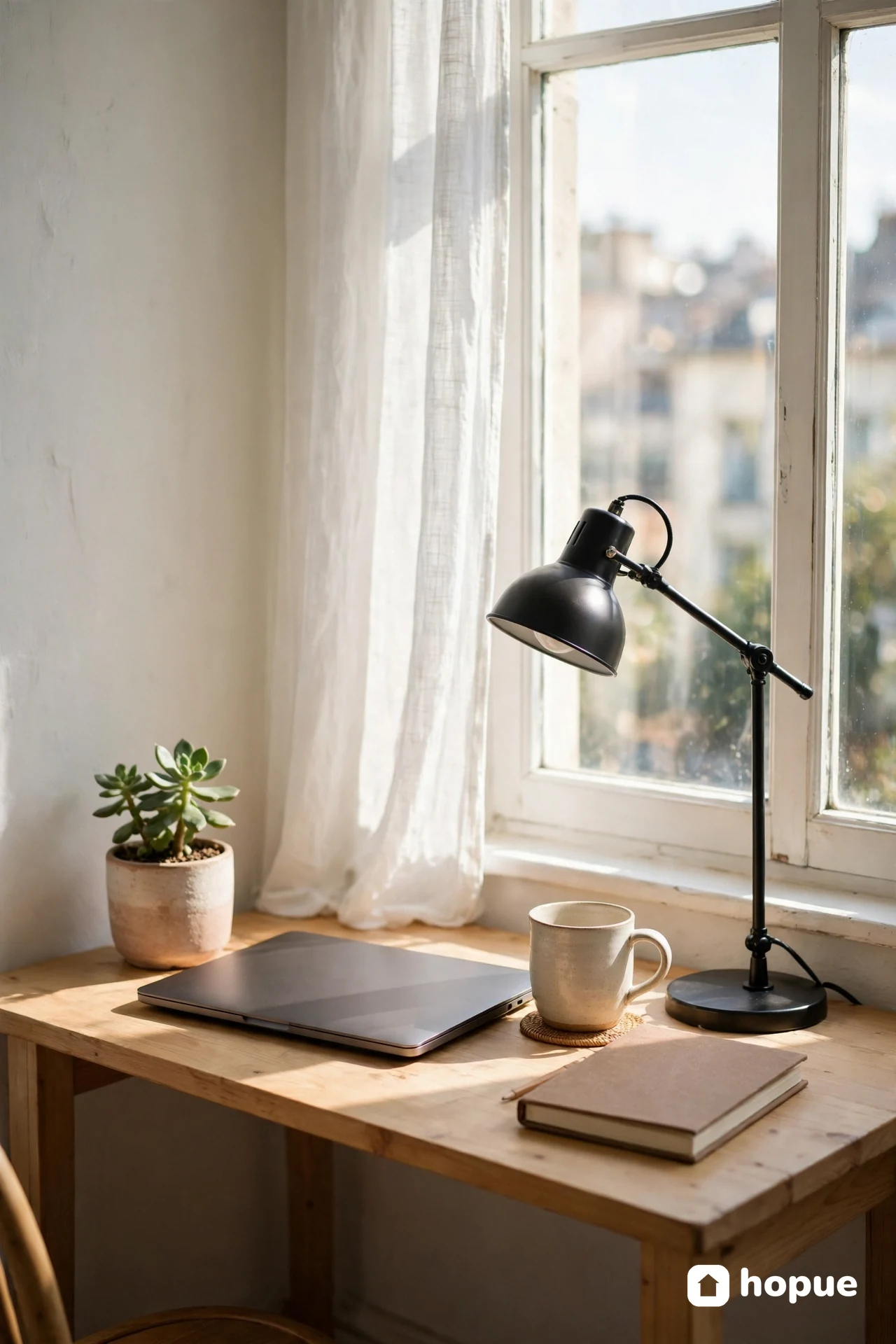
My first work-from-home desk was barely wider than my laptop, wedged between a bed and a wall that got one thin stripe of afternoon sun. Everything I put on it either slid off, blocked the screen, or made the whole corner feel cramped. If you have typed “small desk decor ideas apartment” into a search bar hoping for something that fits a real rental, not a showroom, you are in the right place. These ideas were chosen for desks that have to work hard: a place to type, take calls, pay bills, and still look like somewhere you want to sit down.
The rule I use now is simple. Every object has to earn its patch of desk. If it does not help you work, store something, soften the light, or make you smile when you glance up, it probably belongs somewhere else. All of the ideas below are renter-safe, budget-conscious, and built around keeping the middle of the desk clear. Pick three or four, live with them for a week, and only then add more.
1. A Slim Lamp That Leaves Room to Work
Good light changes everything when your desk faces a wall. I used a chunky lamp for months and lost a third of my surface to its base.
A slim lamp with a narrow foot, or one that clamps to the back edge, gives you the same warm pool of light without stealing space. Pick a warm bulb. Angle the head toward your notebook, not straight at your eyes.
2. One Small Plant, Not a Jungle
One plant is plenty on a tiny desk. A pothos, a snake plant, or a sprig of eucalyptus in a jar softens the hard edges without dropping leaves into your keyboard. I keep mine in the back corner, furthest from my dominant hand, so I never knock it over reaching for coffee. Water it on the same day each week. If your desk gets almost no light, a good faux plant is honest and far less trouble.
3. A Mug That Holds Your Pens
You do not need a fancy desk organiser to start. A sturdy ceramic mug you already own can hold pens, a highlighter, and scissors, and it looks far better than a plastic cup. Mine is chipped on the rim and I like it more for that. Keep it to five or six tools, not twenty. Anything extra goes in a drawer or a bag. Put the mug on the side you do not write with, so your elbow has room. When it starts overflowing, that is your cue to clear it out.
4. A Tray That Keeps the Mess in One Place
A small tray is the difference between clutter spread everywhere and clutter that looks intentional. I use a shallow wooden tray for lip balm, hand cream, a spare charger, and the hair tie that always ends up on my desk.
Everything small lives inside its edge, and the rest stays clear for work. Choose a tray that fits in one corner. Too big, and it becomes another surface to pile things on.
5. A Pinboard You Can Hang Without Drilling
The wall above a desk is free real estate, and a pinboard lets you use it without holes. Hang a small cork board or fabric board with removable adhesive strips rated for its weight, and follow the instructions on the packet. I pin up a train ticket, a postcard from a friend, and the one sticky note I actually need to see. Keep the board small and leave breathing room around each pin. A board crammed edge to edge starts to feel like another to-do list staring at you.
6. One Narrow Shelf Above the Desk
One shelf, hung where you will not bump your head, can hold things that do not need to sit on the desk at all. A candle, a tiny plant, one or two books. If drilling is out, a sturdy adhesive ledge or a shelf that rests on the desk itself can do the same job. I learned to keep the shelf shallow. Deep shelves cast a shadow and make the corner feel boxed in.
7. A Riser That Lifts the Screen and Hides Clutter
A monitor riser or laptop stand does two jobs at once. It lifts the screen closer to eye level, which my neck thanked me for, and it opens up a shallow space underneath for a notebook, a keyboard, or a charging cable. Pick one that is stable and does not wobble when you type. Wood looks warm and blends with most desks. If you buy one with a small drawer, keep it for the flat things that usually drift around: sticky notes, spare batteries, and that one adapter you always lose.
8. A Cable Box and a Few Clips
Cables make a small desk look messy even when it is tidy. A small cable box at the back hides the power strip, and two or three adhesive clips keep charger cords from sliding off the edge. I stuck one clip on the side for my phone charger, so I stopped fishing behind the desk every morning. Run cables along the back edge, not across the middle. On video calls, the difference shows at once.
9. A Short Stack of Books You Actually Read
Two or three books, stacked flat, can raise a small speaker, hold a plant off the surface, or just add colour and height. Use books you have read or plan to read, not a pile bought for show. Mine are a cookbook, a novel with a cracked spine, and a guide to houseplants I keep opening. Stack the largest at the bottom and keep the pile low. A tall tower of books on a small desk wobbles, gathers dust, and ends up in the way of your arm.
10. A Small Clock You Can Glance At
A small analogue clock saves you from checking your phone every few minutes and falling into a scroll. I found a plain one at a thrift store, and its quiet tick is oddly steadying during long sessions.
Put it where you can see it without turning far, but not right in front of your screen. If ticking drives you mad, choose a silent movement. Keep it small. A big clock dominates a tiny desk.
11. One Framed Photo, Not a Gallery Wall
One photo in a small frame is enough. A gallery wall above a desk can feel busy when you are trying to concentrate, but a single picture of people you love, or a place that calms you, gives the corner a personal anchor. I keep mine angled slightly toward my chair, so I see it when I look up from the screen. Choose a frame that matches the desk or the lamp, not one that shouts. If the photo fades in direct sun, move it to the shaded side of the desk.
12. A Reed Diffuser for a Workday Scent
Scent is easy to forget and hard to get right in a small room. A reed diffuser is safer than a candle when you are on calls and might forget an open flame, and it takes up little room. Pick a light scent — cedar, citrus, or clean linen — and start with fewer reeds than the packet suggests. You can always add more. Keep it away from papers and the desk edge, where an elbow could knock it over.
13. A Desk Mat That Marks Your Zone
A desk mat does more than protect the surface. It marks out your work zone, especially if the desk doubles as a dining table or sits in a shared living room. Mine is a plain, dark mat that fits my laptop and notebook with a little room to spare, and nothing else. When I roll it up at the end of the day, the desk goes back to being a regular table. Choose a mat that wipes clean and does not curl at the corners. A mat that slides around will annoy you within a day.
14. A Strip of Removable Wallpaper Behind the Desk
You do not need to paper a whole wall to change how a desk corner feels. A single strip of removable wallpaper behind the desk creates a backdrop that shows up on video calls and makes the space feel finished. I helped a friend put up a subtle linen pattern, and her plain white wall suddenly looked deliberate. Test a small corner first. If it peels paint, it is not worth it.
15. A Standing Calendar You Can See at a Glance
A small standing calendar or weekly planner keeps dates visible without opening another app. I use one that stands on its own at the back of the desk, turned so I can see the week while I am on the phone. Write in pencil if your plans change a lot, like mine do. Keep it compact. A big wall calendar over a small desk can feel like a deadline board, while a modest desk version is just a quiet reminder of what is coming up and what is already done.
16. A Basket Under the Desk for Extras
Not everything needs to live on top of the desk. A small basket under it holds spare notebooks, chargers, headphones, and paperwork you need but do not use every day. Mine is woven and slides out like a drawer. I grab what I need without standing up, and guests never see the mess. Keep it to one basket, and empty it once a month. Two quickly become a cupboard you step around.
17. A Good Coaster and a Real Mug
A proper coaster sounds trivial until you have a ring mark on a rental desk you have to explain later. Use one solid coaster, not a stack of paper napkins, and keep your mug on it every time. I have a cork coaster that has survived three apartments, and it lives in the same back corner as my plant, on the opposite side from my notebook. A favourite mug helps too. Drinking from something you like makes a long afternoon at a small desk feel a little less like a grind.
18. A Small Mirror to Bounce the Window Light
A small mirror, leaned against the wall or hung with adhesive strips, can bounce window light into a dark corner. It also makes a tight nook feel less closed in. I use a round one about the size of a dinner plate, tilted slightly, and it catches morning light without glaring into my screen. Keep it clean. Angle it carefully, though — a mirror that blinds you at noon is worse than none at all.
19. One Bold Colour in an Otherwise Calm Setup
Small desks look best when most things are calm and one thing has personality. That might be a mustard-yellow vase, a deep green plant pot, a bright notebook, or a patterned mug. Everything else stays neutral: wood, white, black, or grey. I tried the opposite once, with five colourful objects competing at once, and the desk looked noisy even when it was tidy. Pick your one bold piece, let it sit where your eye lands first, and change it when you get bored of it.
20. A Bit of Texture Under Your Hands
Texture is what stops a small desk from feeling flat and sterile. A woven placemat under your keyboard, a linen pouch for cables, a cork board, or a soft fabric cover on a hard chair can all add warmth without adding clutter. I drape a small woven runner across the back of my desk, and it softens the hard edge where the desk meets the wall. Mix two textures at most. Too many competing textures on a tiny surface start to look messy, even when every single piece is lovely on its own.
21. One Seasonal Swap, Four Times a Year
Instead of redecorating the whole desk, swap one thing with the seasons. A small pumpkin in autumn, evergreen in winter, a fresh flower in spring, a seashell in summer. That is it. The rest stays the same, so you never reorganise everything or find storage for a box of decorations. I keep mine in the same back corner every time. It marks the season without turning the desk into a display.
22. A Simple Divider for a Shared Desk
Sharing a desk with a partner or roommate is common in small apartments, and a little boundary helps more than you would think. A low book stand, a small plant, or a narrow tray placed down the middle marks where your side ends and theirs begins, without building a wall. My sister and I shared a desk for a year, and a single row of books kept our chargers and notebooks from sliding into each other. Agree on the middle line, keep shared items like the lamp in the centre, and tidy your own side daily.
23. A Tall, Narrow Stand Beside the Desk
When the desk itself is full, go vertical beside it. A tall, narrow plant stand, a slim rolling cart, or a small ladder shelf holds books, a printer, or supplies without taking desk space. I use a narrow cart — printer on top, paper below — and roll it away when I need floor space. Check the gap beside your desk first, roughly, with your hand. A stand that blocks a walkway will be in the way every day.
24. A Thrifted Find With a Story
A thrifted object gives a desk character that new, matching sets rarely do. A brass pen cup, an old tin for paper clips, a wooden box for stamps, or a vintage postcard pinned above the desk all carry a bit of history. I found a small ceramic dish at a charity shop for almost nothing, and it now holds my earrings while I work. Check thrift stores, yard sales, and the free pile in your building. Wash or wipe anything second-hand before it goes near your keyboard, and keep it to one or two pieces.
25. A Print Leaned Against the Wall
You do not have to hang art to enjoy it. A framed print leaned against the wall at the back of the desk adds height and colour, and you can swap it in seconds. I lean a coastline print behind my lamp. It hides the cord and a scuff mark at the same time. Make sure the frame is stable and cannot slide forward onto your laptop — a small non-slip pad underneath helps. On a very shallow desk, choose a small print.
26. A Small Whiteboard for the Week’s Tasks
A small whiteboard, propped at the back of the desk or hung with adhesive strips, holds the three tasks that matter this week and nothing else. I write mine on Monday morning and wipe it clean on Friday, which feels like closing the week properly. Use a fine marker so the writing stays neat, and keep a cloth or eraser tucked behind the board. If a whiteboard feels too office-like, a small chalkboard does the same job with a softer look. Either way, erase often, or it becomes wallpaper.
27. A Hook Under the Desk for Headphones
Headphones left on a desk take up space and end up tangled. A single adhesive hook under the desk, or clamped to the edge, gives them a home that costs no surface at all. I hung mine where my knees do not bump it, and I reach for it without thinking now. Check the weight rating first. A hook that peels off mid-call is a bad surprise. Loop the cord loosely so it does not kink.
28. A Mini Drawer Unit for the Bits and Pieces
Small things multiply on a desk: spare keys, sticky notes, pens that do not fit the mug, receipts, and charging adapters. A mini drawer unit, two or three drawers high, sits at the back corner and swallows all of it. Mine has one drawer for stationery, one for cables, and one for the random bits I cannot throw away yet. Label the drawers if you share the desk. And empty the bottom drawer every few weeks. It is amazing how fast it fills with things you forgot you owned.
29. A Tiny Object That Makes You Smile
Leave room for one thing that has no job at all. A tiny ceramic animal, a smooth stone from a beach trip, a miniature globe, or a funny fridge magnet stuck to a metal board. Mine is a small wooden bird a friend brought back from a trip, and I notice it every time I sit down. It does not store anything, light anything, or organise anything. That is the point. On a desk that has to be practical all day, one small, pointless, joyful object reminds you the corner is yours, not just a workstation.
One last thing worth saying plainly: you do not need all twenty-nine of these. A small desk works best when you choose the few that solve your actual problems, the lamp if the corner is dark, the cable box if cords drive you mad, the tray if small things wander, and leave the rest alone. Start with light, storage, and one personal touch. If the desk still feels crowded after a week, take one thing away before you add anything else. The calmest desks I have seen in small apartments were not the fullest ones. They were the ones where everything left on the surface had a reason to be there.
Frequently Asked Questions
How do I decorate a small desk without losing work space?
Keep the centre of the desk empty and push decor to the back edge and the corners. Use the wall above the desk, a shelf, or a pinboard for display, and choose pieces that do double duty, like a riser with storage or a tray that corrals small items. If you cannot fit your laptop, notebook, and forearms comfortably, remove one decorative object before you add another. Live with a lean setup for a week and notice what you actually reach for.
What can I hang above a desk without drilling?
Removable adhesive strips, adhesive hooks, and lightweight cork or fabric boards are the usual renter-safe options, as long as you follow the weight limits on the packet and clean the wall first. Light frames, small mirrors, and a single narrow shelf designed for adhesive mounting can all work. Avoid heavy frames and anything valuable over your laptop. If a strip fails in a hot or humid room, try a leaning print or a board propped on the desk instead.
How do I keep cables tidy on a small desk?
Start with fewer cables, not more organisers. Unplug chargers you do not use daily, then hide the power strip in a small cable box at the back of the desk. Use two or three adhesive clips along the back edge to stop cords sliding off, and route everything behind the desk rather than across it. Coil spare length loosely with a reusable tie. Check the setup after a week, because cables creep back onto the surface if you do not catch them early.
What lighting works best for video calls at a small desk?
Face a window if you can, with the light in front of you rather than behind you, so your face is lit and the background is not blown out. If there is no window, use a small desk lamp with a warm bulb placed to the side of your screen, angled toward your face, not straight into the camera. Avoid a bright overhead light directly above you, which casts shadows under your eyes. Test the setup on a quick call with a friend before an important meeting.