29 Small Apartment Hallway Decor Ideas
Most hallways in small apartments get ignored. They are too narrow for furniture, too dark for plants, and too plain to bother with. So they stay blank. White walls, a scuffed floor, a light you only switch on to get from one room to another.
I have lived in places like that, and the hallway always felt like the part of the apartment that belonged to the building, not to me. Then I started treating it like a room in its own right, just a skinny one. A runner underfoot, something worth looking at on the wall, a light that felt warm instead of harsh. It did not take much money, and nothing I did needed a drill or a landlord’s permission. The hallway still moved people from room to room. It just stopped feeling like a gap between rooms.
These ideas are all renter-safe and built for the hallways renters actually have: narrow passages, entry halls, the strip by the front door, and those dim stretches with no window at all. Pick one or two to start. A hallway does not need all 29. It needs enough to feel finished.
1. Start With a Slim, Washable Runner
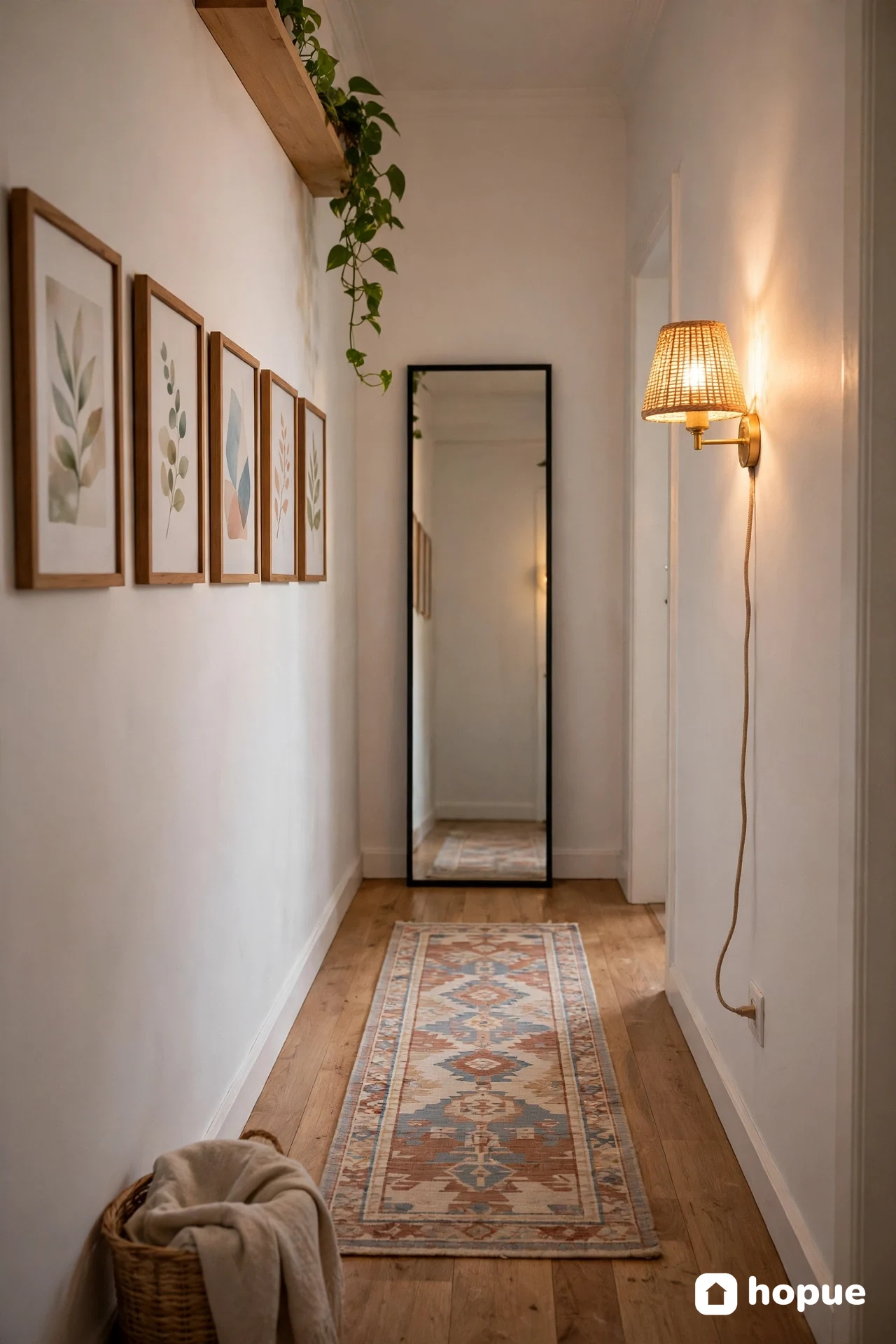
A runner changes a hallway faster than anything else on this list. Bare rental flooring can look cold and a bit tired, especially in a long passage. A slim runner softens the sound of footsteps, warms up the color, and gives the eye somewhere to go. In my last apartment, the hallway floor was a pale vinyl that showed every mark. The runner hid most of it and made the whole walk feel calmer.
Washability matters more than pattern here. Hallways collect dust, shoe dirt, and pet hair faster than any other floor in the place. A machine-washable runner, or one you can shake out and spot-clean easily, will save you from dreading the dirt. Leave a strip of floor showing on each side. That breathing room keeps a narrow hall from looking stuffed, and it stops the rug from catching on door swings.
2. Try Peel-and-Stick Wallpaper on One Wall
One wallpapered wall can carry a whole hallway. You do not need to cover every surface, and in a rental you should not. Pick the longest wall, or the wall you see first when you walk in, and leave the rest plain. A small print, a soft stripe, or a faded botanical pattern reads well in a tight space. Big, loud prints can close a narrow hall in fast.
Peel-and-stick paper comes off without taking paint with it when it is removed slowly and the wall underneath was clean to start with. That last part matters. Wipe the wall down first, let it dry, and press the paper on in short sections. If your lease is strict, keep the receipt and a photo of the bare wall from move-in day. I kept mine in a folder on my phone. It took two minutes and saved a whole argument later.
3. Hang a Straight-Line Gallery in Matching Frames
A gallery wall in a hallway works best when it stays tidy. In a wide living room, a scattered cluster looks relaxed. In a narrow passage, that same cluster can look messy because you see it up close and from the side. A single straight line of frames, all the same size and color, keeps things calm.
Set the line at eye level, keep the spacing even by eye, and step back often. The art inside can be anything: prints you already own, postcards, pages from an old calendar, drawings your kids made. The matching frames are what make it look deliberate. Mix black frames with white mats if the hall is dark. The white mats catch what little light there is and keep the row from turning into a dark stripe.
4. Put a Large Mirror at the End of the Hall
A mirror at the end of a hallway does two jobs at once. It bounces light back down the passage, and it gives a dead-end wall a purpose. In a windowless hall, that matters more than any other trick here. You are not trying to fool anyone into thinking the hall is bigger. You just want it to feel less like a tunnel.
Lean a tall mirror against the end wall if you cannot hang anything heavy, and anchor the top with a removable hook or a strip meant for mirrors if your lease allows it. A thin frame in brass, black, or natural wood keeps the look light. Avoid a mirror that faces a bedroom or bathroom door if the reflection will flash light into someone’s eyes at night. Walk the hall after dark once it is up. You will know right away if the angle is wrong.
5. Swap Harsh Overhead Light for Plug-In Sconces
Most rental hallways have one bare overhead light that makes everything look flat and a little grim. Plug-in sconces fix that without any wiring. They plug into an outlet, the cord runs down the wall in a slim cover, and the shade throws light sideways instead of straight down. The difference at night is hard to overstate. The hall stops feeling like a corridor and starts feeling like part of the home.
One sconce on each side works if you have the outlets, or a single one near the middle if you do not. Warm-toned bulbs help most. Cool white light in a narrow hall can feel like an office. If the cord cover bugs you, paint it the wall color before you stick it up, or run it tight along a corner where the eye skips over it. Landlords rarely object to a cord cover. It comes off clean and leaves no mark.
6. Hide a Soft Glow Line Along the Top of the Wall
Sometimes a hallway does not need a new lamp. It needs a wash of light that has no visible source. A slim adhesive light strip tucked along the top edge of a wall, behind a picture ledge, or under a high shelf does that job. Turned low, it glows like evening light. Turned up, it can make a dark hall usable without the overhead bulb at all.
The strip itself should stay out of sight. You want to see the light, not the thing making it. Run it only where it will not be kicked or peeled off by passing bags and coats. Battery versions exist if there is no outlet nearby, though they need fresh batteries more often than you expect. I learned to buy rechargeable ones and keep a spare set charged. A dead strip in a dark hall is worse than no strip, because you keep reaching for a switch that is not there.
7. Lean One Big Piece of Art Against the End Wall
Not every hallway wall needs a collection. One large piece, leaned against the end wall, can hold the whole space. It works especially well where the hall ends in a blank wall with no door. The art becomes the destination. You walk toward it instead of toward a wall.
Something with breathing room in it works best: a landscape, a soft abstract, a large photograph with sky in it. Dark, busy art at the end of a dark hall can feel heavy. Lean the piece with its bottom edge flat on the floor and the top resting lightly on the wall, and put a small felt pad behind the top corners so it does not scuff the paint. If you have kids or a dog who barrels through, skip the lean and hang it with proper removable hardware instead. A leaning frame in a busy hallway is a falling frame waiting for a reason.
8. Add a Narrow Picture Ledge Instead of Holes Everywhere
A picture ledge is a slim shelf that lets art sit instead of hang. In a hallway, that is a gift. You can layer two or three small frames, swap them when you get bored, and never put another hole in the wall. The ledge itself goes up with a few removable strips or screws if your lease allows them, and then the art on top is free to change.
A shallow ledge is the whole point here. Anything that sticks out far will catch shoulders and bags. Put the heaviest frame at the back, against the wall, and smaller pieces in front of it, slightly overlapping. That layered look is forgiving. A frame that is a little crooked still looks fine when it is leaning on a ledge. On a nail, the same crooked frame just looks wrong. Dust the ledge when you dust the frames. It collects dust in a thin, even line that shows up in sideways light.
9. Make Hooks the Decoration, Not Just the Storage
Hooks in a hallway usually look like an afterthought: a row of mismatched plastic hooks holding coats. Choose hooks worth looking at and the whole wall changes. Brass hooks, matte black hooks, wooden pegs, ceramic knobs on a rail — any of these can read as decor first and storage second. Leaving some hooks empty on purpose is what makes it work.
A rail or a row of individual hooks, fixed with removable adhesive and spaced evenly, works well. Let one or two stay bare. Hang a hat on one, a small tote on another, and leave the rest as a pattern on the wall. When every hook is loaded, the wall disappears under coats. When a few are bare, the hooks themselves are the pattern. Take everything off once a month and wipe the wall behind the rail. Coat hooks hide dust and pet hair in a way that only shows when guests arrive.
10. Dress Up the Front Door Itself
The front door is usually the biggest surface in an entry hall, and renters tend to leave it exactly as they found it. You cannot paint it in most leases, but you can dress it. A seasonal wreath, a hanging textile, a removable door decal in a soft arch shape, or a simple linen curtain hung from a tension rod on the inside of a glazed door all change the feel of the whole entry.
Light and flat is the rule for anything hung on a door. Anything bulky on a door gets knocked every time someone comes in with groceries. A slim wreath on a removable over-door hook is the safest bet. If your door has a peephole or a knocker, work around them rather than covering them. I once hung a wreath that blocked the peephole for a month before a delivery driver knocked and I could not see who it was. Small detail, real annoyance. Check the sightline before you call it done.
11. Hang a Woven Wall Hanging for Softness
Hallway walls are hard surfaces: paint, wood, glass, mirror. A woven wall hanging breaks that up. The texture catches light differently than a framed print, and it softens sound a little, which helps in a long, echoey passage. A hanging with fringe, knots, or layered fibers reads warm even in a hall with no natural light.
A single removable hook, or a slim wooden dowel on two hooks, will hold it. Keep it away from the path of swinging doors and coat sleeves, or the fringe will tangle and fray. A small hanging suits a narrow hall better than a huge one. A huge textile in a tight space can feel like a curtain you have to push past. If you buy secondhand, air it outside first and check the back for dust. Thrifted textiles can hold smells that only show up once they are inside a warm hallway.
12. Run a High Shelf for Trailing Plants
Plants in a hallway sound impossible until you go high. A shelf fixed near the top of the wall, well above head height, holds trailing plants that spill down without blocking anyone. Pothos is the classic choice because it tolerates low light and forgetful watering. A spider plant or a trailing philodendron does the same job.
Real plants make sense if the hall gets even a little borrowed light from nearby rooms. If it gets none, use good fake trailing plants and be honest about it — a dusty fake plant is worse than no plant. Water real ones over the sink, not on the shelf, and let them drain fully before they go back up. I ruined a shelf edge once by putting a plant back while it was still dripping. The water ran down the wall in a line I noticed a week later. A saucer under each pot on the shelf is not optional.
13. Anchor the Far Corner With One Floor Plant
One large floor plant at the end of a hall, in a corner where nobody walks, gives the space a living anchor. It is a different move from the high shelf above. Down low, the plant reads as furniture, something solid at the end of the passage. A fiddle-leaf fig is popular, but a snake plant or a tall ZZ plant is far more forgiving in low light and dry rental air.
Pick a pot that is heavy enough not to tip if someone brushes past it, and put a felt pad under it so it does not scratch the floor. Keep the plant out of the direct path to a door. A plant you have to step around every day will get knocked, and you will start resenting it. If the corner is truly dark, rotate the plant into a brighter room for a few days every couple of weeks. It will not thrive in a windowless hall forever, but a rotation keeps it looking decent for a long time.
14. Style a Small Stool With Found Objects
A small stool by the door or at a bend in the hall is a chance to show things you actually like. Not a storage unit. A surface. A thrifted vase, a stack of two books you have read, a stone picked up on a walk, a candle you never light. The objects matter less than the fact that they were chosen. A hallway with one personal surface feels lived in. A hallway with none feels like a show flat.
Change the objects when you get bored. That is the point. A stool vignette that never changes goes invisible after a month. Swap in a new find, a photo, a small plant cutting in water. Keep the stool low and stable, and keep nothing breakable on it if the hall is a main route for kids or pets. I lost a favorite vase that way in a place with a narrow hall and a dog who turned corners at full speed. The vase was lovely. The hallway won.
15. Use One Long Panoramic Photo Instead of Many Small Ones
A single long photo — a coastline, a city skyline, a row of trees, a horizon from a trip — suits a hallway in a way a grid of small photos does not. Hallways are long and low. A panoramic shape matches that. It reads as one calm band of image instead of a busy cluster, and it is easy to hang with two removable strips.
Print it wide and keep the frame slim. A heavy frame on a long print can bow or pull at adhesive over time, so check the weight before you commit to strips. If the print is a personal photo, print it properly rather than at home on thin paper. A washed-out home print in a hallway with warm light can look tired within weeks. A proper print holds its color and makes the whole idea feel intentional instead of improvised.
16. Clip Photos to a Line You Can Change in Minutes
Some photos deserve to be up for a week, not forever. A length of string, wire, or slim cord strung along a hallway wall, with small clips holding prints, postcards, and ticket stubs, gives you a display that changes as life does. New photos go up after a trip. Old ones come down without any wall damage.
Use washi tape, mini clips, or small wooden pegs, and keep the line high enough that bags do not snag it. The charm of this idea is its impermanence, so do not overthink the arrangement. A slightly uneven line looks human. A perfectly measured line looks like a shop display. Replace faded prints when the hall light bleaches them. Sun from a nearby room can fade prints on a hallway line faster than you expect, especially on the side that faces a doorway.
17. Set a Low Bench or Pouf at the End of the Hall
A bench in a hallway sounds like a luxury, but a low pouf or a slim bench at the end of a passage changes how the space feels. It gives the eye a place to rest and gives people a place to sit while they pull on shoes, even if the bench is technically in the hall, not the entry. Choose upholstery or a cushion in a color that warms the hall: rust, olive, deep green, warm cream.
Low is better than tall here, and a small footprint matters more than a long bench. A tall bench in a narrow hall blocks the view down the passage and makes the space feel shorter. A low one lets the eye travel over it to the wall beyond. If the bench is near the front door, put a small tray or a folded throw on it and leave the rest bare. A bench piled with bags and mail stops being decor and becomes a dumping ground within days. I speak from experience. The throw is what keeps it looking like a choice.
18. Treat the Floor With Removable Floor Decals
When the walls cannot change much, the floor can. Removable floor decals and peel-and-stick floor tiles made for renters can lay a pattern down the middle of a hallway: a checkerboard strip, a border, a faux tile runner that looks painted on. It is a bolder move than a rug, and it suits renters who want pattern without buying a large rug.
Test one piece first, in a corner that gets walked on a lot. Some decals lift at the edges on textured rental flooring or in humid entry halls. If the test piece stays put for a week of normal traffic, lay the rest. If it curls, stop. A curling edge in a hallway is a trip hazard and a constant annoyance. Keep the pattern simple and the colors close to the floor you already have. A wild pattern underfoot can make a narrow hall feel busy in a way that is hard to live with.
19. Hang a Swag Pendant Light in the Middle of the Hall
A swag pendant is a plug-in light that hangs from a ceiling hook and drapes its cord in a soft curve to the wall and down to an outlet. In a hallway, it turns lighting into a feature. The pendant hangs lower than the ceiling light, so the glow lands at eye level and feels warm and close. A paper shade, a rattan shade, or a simple linen drum all work.
The middle of the hall is the spot, not over a doorway, so nobody walks into it. Use a removable ceiling hook rated for the weight, and check that the hook holds before you leave the light hanging overnight. The cord should hug the wall in a cover or a series of small clips, not dangle loose where it can be grabbed. If your ceiling is very low, skip this idea. A pendant that forces tall guests to duck is not charming. It is a hazard with a shade on it.
20. Add Peel-and-Stick Trim for a Paneled Look
Flat rental walls can look a little bare, even with art on them. Peel-and-stick trim strips, laid out in rectangles on the wall, give a hallway the look of paneling without any woodwork. Paint the strips the same color as the wall for a quiet, architectural feel, or a shade darker for more contrast. The rectangles break up a long wall and give the eye a rhythm to follow.
Plan the layout on paper first, or with painter’s tape on the wall, before you stick anything down. Uneven rectangles will bother you every time you walk past. Keep the rectangles the same height and space them evenly, and stop the pattern before a doorway so it does not look cut off mid-thought. Remove the strips slowly at move-out, warming them gently if they resist. Rushing the removal is how paint comes off, and paint is what the deposit is watching.
21. Use Removable Arch Decals as Color Blocks
Arches are everywhere in decor right now, and in a hallway they make sense. A large arch decal on a wall creates a focal point without any furniture. Put a small ledge, a hook, or a single framed print inside the arch, and the arch frames it. The color does the work: a warm clay arch in a white hall, a deep green arch in a cream hall, a soft blush arch in a gray hall.
One arch is enough, or a pair of matching arches on opposite walls. A hall covered in arches stops looking like a hall and starts looking like a pattern sample. Place the arch where it will be seen head-on, not from a sharp angle. From the side, a flat decal can look like a smear of color. From the front, it reads as a shape. If the decal starts to peel in a humid entry hall, press it back down and check the wall behind it for damp. A peeling decal is usually telling you something about the wall, not the sticker.
22. Hang Woven Baskets Flat as Wall Art
Baskets do not have to hold things. Hung flat against a hallway wall, a group of shallow woven baskets becomes texture art. The weave, the rim, the slight differences in color — all of it reads warm and handmade. This works well in halls that already have a lot of framed, flat art and need something with depth.
Three or five baskets in a loose cluster work well, mixing sizes but keeping the palette close: natural seagrass, warm rattan, one dark basket for contrast. Use removable hooks that hold the weight, and hang the baskets by their rims or by a loop of twine through the weave. Check that they sit flat. A basket that tips forward will cast a strange shadow and collect dust on its underside. Dust them with a dry cloth. A damp cloth on seagrass can leave marks that do not come out.
23. Keep One Frame That Rotates With the Season
A hallway is a good place for a single rotating display because you pass it every day. One frame, one hook, one print that changes with the season. A snowy scene in winter, a green print in spring, a beach photo in summer, warm leaves in fall. The frame stays. The art inside does the changing.
Buy a frame that opens easily from the back, or use a clip frame where the print slides in from the top. If changing the art is a chore, you will not do it, and the frame will hold the same print for two years. Keep a small folder of prints in a closet nearby, sized to the frame, so a swap takes a few minutes. This is a small idea with an outsized effect. Guests notice it. They notice that something changed, even if they cannot say what, and that is exactly the feeling a hallway should give.
24. Style a Scent Vignette on a Ledge
A hallway is the first thing you smell when you walk in. A small ledge with a candle, a reed diffuser, or a bowl of dried citrus becomes both decor and welcome. The objects are the decor: a handsome candle in a ceramic vessel, a diffuser with slim reeds, a small dish holding matches. The scent is the bonus.
Flames need distance from curtains, hanging textiles, and coat sleeves. In a narrow hall, a lit candle on a low ledge is a risk. Use a diffuser or an unlit candle as the visual piece and light candles only when you are home and awake. Put the ledge high enough that a passing bag does not knock the diffuser over. Reed diffuser oil on rental flooring is a stain that does not come out, and it smells, in the worst way, for weeks. A small tray under the diffuser catches drips and makes the vignette look finished.
25. Pair a Door Mat With the Runner
The strip by the front door is part of the hallway, and it deserves its own treatment. A door mat that relates to the runner — same color family, a shared pattern, a similar texture — makes the entry feel planned instead of pieced together. The mat takes the dirt. The runner takes the eye. Together they mark the threshold.
Choose a mat that is low enough for the door to swing over it. A thick mat that catches the door will bunch up, and you will kick it straight every morning. Shake the mat outside often, especially in wet weather, and put a non-slip pad under it if the floor is slick. The pad matters more than the mat. A mat that slides on a hard floor is a fall risk, and it will creep across the hallway a little further every day until it blocks the runner. Check the mat’s position when you get home. It takes three seconds.
26. Add a Personal Number or Initial Plaque
A small plaque with your house number, your initial, or your family name gives a hallway a sense of place. It is the kind of detail that makes a rental feel like yours without changing anything structural. A brass number, a wooden initial, a ceramic tile with a name — any of these work, as long as it is small and hung with care.
Near the front door, at eye level, is where it reads as a greeting. Keep it to one plaque. A wall of initials and numbers looks like a shop sign. If your building has rules about what can show on the outside of the door, keep the plaque inside, on the hallway side. That is where you will see it anyway. Use a removable strip or a single small hook. A plaque that is slightly crooked will draw the eye every time, so take a moment to level it. Step back, look, adjust. It is a small job that pays off daily.
27. Frame a Chalkboard or Memo Board as Art
A framed chalkboard or a memo board in a hallway is useful and good-looking at once. Notes, a grocery list, a reminder to water the plants, a quote you like this month — all of it lives in one tidy frame instead of scattered sticky notes. In a rental, a board hung with removable strips is far kinder to the walls than a dozen pinned notes.
A board whose frame matches the other frames in the hall reads as art, not office equipment. A black chalkboard in a dark wood frame, or a linen memo board in a brass frame, both blend in. Keep the writing tidy and change it often. A board with last month’s notes on it stops being decor and becomes clutter with a frame. Wipe chalk dust off the frame and the wall below it when you rewrite. Chalk dust drifts, and it shows on dark floors.
28. Use Shiny and Metallic Frames to Bounce Light
In a dark hallway, the frames matter as much as the art. Matte black frames absorb what little light there is. Brass, gold, silver, and glass frames catch it and throw it back. A row of metallic frames along a windowless hall can lift the whole space without adding a single lamp.
Mix metals if you like, but keep the finish consistent in tone: warm metals together, cool metals together. A warm brass frame next to a cool chrome frame can look accidental. The glass needs a wipe more often than you would think. Fingerprints and dust show fast on metallic frames in sideways light, and a smudged frame in a dark hall reads as dull, not shiny. A quick wipe with a dry cloth when you pass is enough. This is a quiet idea, but in a hall with no window, quiet ideas are the ones that work.
29. Compose a Trio Vignette at the Dead End
Every hallway has a dead end, a wall where the passage stops. Treat that wall as a small stage. Three things, arranged as a group: a piece of art hung at eye level, a slim stool or plant stand below it, and a vase, a book, or a small object on the stand. The three things should relate — a shared color, a shared material, a shared mood — without matching exactly.
Step back and look at the group as one shape. If one piece dominates, swap it for something smaller. If the group feels flat, add height with a taller vase or a trailing plant. This vignette is the last thing you see when you walk down the hall, so it sets the feeling you carry into the next room. Make it calm. A busy, cluttered dead end makes the whole hallway feel cramped, even if the rest of it is bare. A calm trio makes the hallway feel finished, like someone meant it to look this way.
A hallway does not need to be grand to feel good. It needs a soft floor underfoot, something worth looking at, light that does not glare, and a few details that say someone lives here. Start with the runner and the light, add one wall idea that suits your lease, and let the rest follow slowly. The best rental hallways I have seen were not decorated in a weekend. They were built up one removable, renter-safe choice at a time, and they still gave the deposit back at the end.
Frequently Asked Questions
How do I decorate a hallway with no windows and no natural light?
Lean on light, reflection, and warm color. A large mirror at the end, metallic frames, and a plug-in sconce or a hidden glow strip will do more than any wall color. Keep art light in tone, with white mats and pale backgrounds, and avoid filling a dark hall with dark, heavy pieces. If you use plants, choose low-light types and rotate them into a brighter room regularly, or use good fake trailing plants and keep them dusted. A dark hallway can feel cozy rather than gloomy when the light is warm and low instead of harsh and overhead.
My hallway is very narrow. How do I decorate without blocking the walkway?
Keep everything flat or high. Art, mirrors, decals, and trim sit on the wall and take no floor space. Shelves and ledges should be shallow enough that shoulders and bags pass without catching. Leave floor decor to the very end of the hall or to a single corner nobody walks through. A slim runner with floor showing on each side helps more than a wide rug, which can bunch at doorways. Walk the hall with a laundry basket or a grocery bag after you decorate. If you have to sidestep anything, it is too far out.
What can I hang if my lease says no holes in the walls?
Use removable adhesive strips and hooks rated for the weight of each piece, and follow the removal instructions exactly at move-out. Light frames, decals, peel-and-stick wallpaper, leaning art, and picture ledges held with strips all work without nails. For heavier mirrors, ask your landlord in writing before you hang anything, and keep the reply. Test one strip in a hidden spot first, especially on fresh paint, and clean the wall before you stick anything down. A strip that fails usually failed because the wall was dusty or the weight was wrong, not because the product was bad.
How do I keep a runner from sliding on rental floors?
Use a rug pad made for hard floors, cut to sit just inside the edges of the runner so it does not show. A pad with a grippy surface on both sides holds better than a thin foam pad, which can bunch up. Make sure the floor underneath is clean and dry before you lay the pad down. In an entry hall, check the runner after wet weather, since water under a rug can make even a good pad slip. If the runner still creeps, try a pad with a different grip, or choose a heavier runner. A light runner on a slick floor will move no matter what you put under it, and it is not worth a fall to keep it.
Can I add better hallway lighting without an electrician or rewiring?
Yes. Plug-in sconces, swag pendants, adhesive light strips, and battery puck lights all add light without touching the wiring. Plug-in options are the most reliable because they do not need batteries, but they need an outlet and a tidy cord cover. Battery lights suit spots with no outlet, though you will need to recharge or replace batteries regularly. Choose warm-toned bulbs for a hallway, since cool light can feel harsh in a narrow space. Keep cords tight to the wall and out of the walking path, and never run a cord under a rug, where it can overheat and wear unseen.