29 Nightstand Styling Ideas for a Small Bedroom
In a small bedroom, the nightstand takes a beating. It holds the lamp, the phone, the water glass, the book you meant to finish last month, and whatever else did not have a home that day. By the end of the week it looks less like a styled surface and more like a landing strip. I have lived with that version, in rentals where the bedroom barely fit the bed, and the fix was never a bigger nightstand. It was deciding what earned a spot and what had to go somewhere else.
These are nightstand styling small bedroom ideas built for that reality — rented rooms, tight floors, and budgets that do not stretch to a full furniture swap. Every idea below works with what you already own or with one small, cheap change. Pick two or three to start. A nightstand that works for your actual nights beats a perfect-looking one you are afraid to touch.
1. Pick a Lamp That Fits the Surface, Not Just the Room
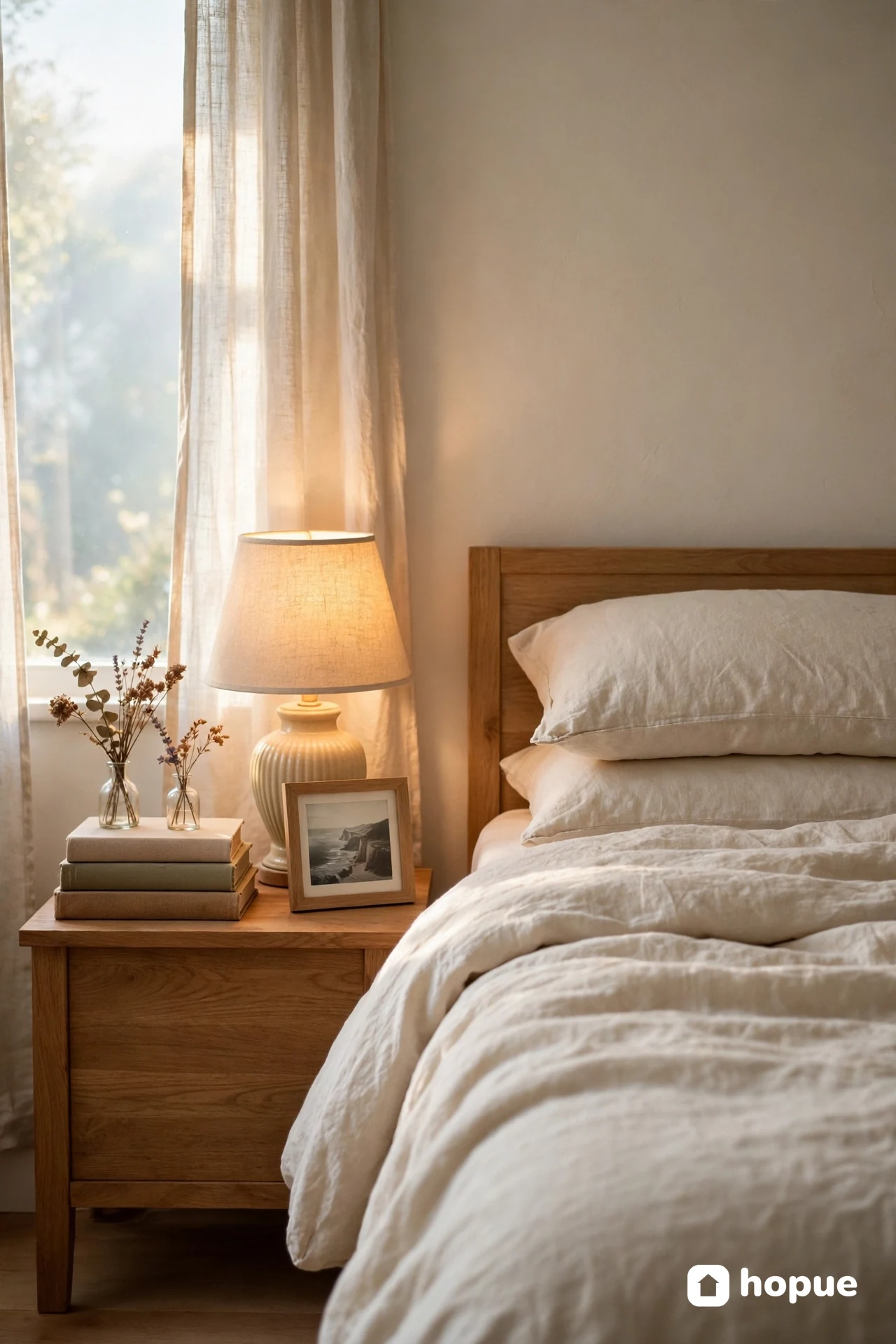
A lamp that is too wide eats the whole top before you put anything else down. Look for a slim base and a shade that does not stick out past the edge of the nightstand. I once bought a lovely chunky lamp for a rental bedroom and spent three months moving it aside every time I needed room for a book. A narrower lamp with warm light did the same job and left space to breathe. If your nightstand is really tiny, a lamp with a small footprint matters more than how pretty the shade is in the store.
2. Add a Tray and Let It Do the Editing
A tray gives clutter a border. Without one, lip balm, keys, hair ties, and loose change spread until the whole surface is covered. With one, you see at a glance when it is full. Use a thrifted plate, a wooden board, or a shallow basket — it does not need to match anything. Keep only what you reach for at night inside it. When the tray starts to overflow, that is your signal to move something out, not to find a bigger tray. The rest of the top stays clear, mostly.
3. Keep a Short Stack of Books You Actually Read
Two or three books stacked flat look settled. Ten books look like storage. Pick the one you are reading now, one you dip into, and maybe a small journal. Turn the spines so the colours sit well together, or face them all the same way if that calms your eye. Rule of thumb: a book unopened for a month goes back on the shelf. The stack stays low, it doubles as a riser for a candle or a small clock, and it tells the truth about what you read.
4. One Small Plant, and Nothing That Needs Constant Care
A tiny plant softens a hard corner fast, but a small bedroom is a hard place for a fussy one. Low light, dry air from heating, and a spot right by the bed where you might knock it over — pick something tough. A small pothos, a snake plant cutting in water, or a sprig of dried stems in a vase all work. I killed two ferns before I learned that lesson. Dried stems are the honest choice if you travel or forget to water. One plant is enough. Two starts to feel like a shelf at a garden shop.
5. A Candle You Only Light at Night
A candle on the nightstand works best when it has a job: marking the end of the day. Keep it in a jar with a lid so dust and bedding lint stay out, and set it on a coaster or a small plate. Never leave it burning while you fall asleep — I blow mine out when I pick up my book, and that little habit is part of the wind-down. Unscented is safer if you are sensitive to smells in a closed room. When it is not lit, the jar itself still looks finished, which is half the point.
6. A Clock You Can Read Without Your Phone
Reaching for your phone to check the time at 3 a.m. usually ends with scrolling. A small analog clock, or a simple digital one with a dim display, breaks that loop. Pick one with a face you can read half-asleep and a light that will not glow across the whole room. I moved my phone charger across the room and put a cheap clock on the nightstand instead, and my sleep got noticeably better within a week. It also frees up the nightstand from being a phone dock, which changes how the whole surface feels.
7. Hide the Chargers in a Small Box or Pouch
Cables are what make a styled nightstand look messy in photos and in real life. You do not need a fancy cable system. A small lidded box, a zip pouch, or even a mug can hold a charging brick and the extra cord length. Run one short cable out for the phone and tuck the rest away. Keep the box at the back corner, away from water. It takes two minutes to set up and it hides the tangle that otherwise creeps across the top every night. Renters, this is fully reversible — no clips screwed into anything.
8. Use the Space Underneath With a Low Basket
If your nightstand has open space below, that gap is storage waiting to happen. A low, flat basket slides in and holds spare chargers, extra bedding, or the books you are not reading right now. Measure roughly with your hand — a basket that sticks out past the legs will catch your shin in the dark, and I have the bruise to prove it. Woven baskets warm up a plain wooden nightstand, and fabric bins work if you want everything fully hidden. Just keep it to one basket. Two stacked underneath starts to look like a cupboard.
9. Hang One Piece of Art Just Above the Nightstand
One small framed print above the nightstand pulls the eye up and makes the whole corner feel deliberate. It works better than a cluster here, because a cluster crowds a small wall and competes with the lamp. Use removable strips or a single nail if your lease allows it — check first, and keep the frame light. Pick art that means something to you, not a filler print. A photo you took, a postcard from a trip, a small line drawing. Leave a little breathing room between the frame and the lamp so neither one feels squeezed.
10. Make Scent Part of the Setup, Not an Afterthought
A small bedroom holds scent well. One scent source is plenty: a reed diffuser tucked at the back, a small sachet in the drawer, or the candle from idea five. Layering all three will overwhelm a closed room fast. I learned that after combining a diffuser and a strong candle in a studio bedroom — it gave me a headache before bed. Go light, and pick something you like at night, not just in the shop. Lavender and cedar are common for a reason, but plain clean linen scents work just as well.
11. A Carafe and Glass, With a Coaster That Stays Put
A small carafe means no trips to the kitchen at midnight, and it looks far tidier than a random water bottle. The trick is the coaster. A cork or stone coaster that grips the surface keeps water rings off wood and stops the glass sliding when you reach for it half-asleep. Fill the carafe in the evening and empty it in the morning so water does not sit for days. If space is truly tight, skip the carafe and use one sturdy glass. The point is water, close by, without a wet ring marking the wood by spring.
12. Split One Nightstand Down the Middle for Two People
Sharing one nightstand in a small bedroom is a negotiation, and styling it helps. Give each person a half: your lamp and book on one side, their charger and glass on the other. A tray on each side, or one long tray split by a small object in the middle, keeps the line clear without a formal argument. Talk about it once, agree on the split, and stop rearranging each other’s half. We did this where a second nightstand would have blocked the closet door. It worked because the boundary was visible.
13. Go Narrow or Go Floating When Floor Space Is Gone
When the bed nearly touches the wall, a standard nightstand will not fit, and forcing one in makes the room harder to walk through. A narrow console, a wall-mounted shelf on removable brackets, or a floating ledge gives you a surface without legs eating floor space. Floating shelves need solid fixing, so if your walls are plaster or your lease is strict, a narrow legged table you can move is the safer bet. Keep what sits on it light — lamp, book, glass — and store the rest elsewhere. Narrow beats crowded, every time.
14. Let a Thrifted Find Set the Tone
A secondhand nightstand, a chipped ceramic dish, or an old brass tray can carry the whole corner and cost very little. Thrifted pieces bring a shape or colour you would not pick new, and that stops the room looking like a showroom set. Check drawers slide, legs sit level, and there is no strong smell before you bring it home. A small wooden nightstand with one drawer, bought for almost nothing and sanded lightly on top, outlasted two newer ones. One strong thrifted piece is enough. Let it lead, and keep everything else quiet around it.
15. Add Colour in One Small, Swappable Spot
Colour on a nightstand is best in one spot you can change cheaply: a book cover, a small vase, a candle, a cloth under the lamp. Try deep green in winter, soft blue in summer — no repainting. Keep the nightstand itself and the lamp neutral so the colour reads as a choice, not a clash. I rotate a single small vase — dried stems in autumn, a fresh stem when I have one — and the whole corner shifts with it. If the colour starts to fight with your bedding, swap just that one object. Done.
16. Mix Three Textures and Stop There
Wood, linen, and ceramic. Metal, glass, and woven fibre. Pick three textures and let them repeat in small ways across the nightstand. The mix keeps a plain surface from looking flat, and the limit keeps it from looking busy. A wooden tray, a linen-covered book, and a ceramic lamp base is a combination that works in almost any rental bedroom. I overdid this once with rattan, velvet, marble, brass, and glass all on one small top, and it just looked restless. Three is a good ceiling. If you add a fourth, take one away first.
17. Try Asymmetry When Matching Sets Feel Too Stiff
Matching nightstands and matching lamps can look tidy, but in a small bedroom they can also feel stiff and take up visual room. Try one lamp and one stack of books on one side, and a plant and a clock on the other — or just style the single nightstand you have off-centre. Put the lamp at the back corner, the books to one side, and leave the other side open. It feels more lived-in and less like a furniture display. Asymmetry also helps when the bed is not centred on the wall.
18. Swap One Thing With the Seasons
You do not need a full seasonal redecorate. Swap one object on the nightstand four times a year and the room feels fresh without spending much. A heavier candle in winter, a small bud vase in spring, a woven tray in summer, dried stems in autumn. Keep the swapped item in a box in the closet between seasons so it stays clean. I keep a small bag labelled by season and the swap takes five minutes. The lamp, clock, and tray stay put — only the seasonal piece moves. That limit is what keeps it feeling calm instead of cluttered.
19. Paint or Line a Plain Nightstand Instead of Replacing It
A plain, scuffed nightstand does not need replacing. A coat of paint on the drawer front, new knobs, or removable lining paper inside the drawer can make it feel new for very little money. Use furniture paint, ventilate well, and let it dry fully first. Removable wallpaper or contact paper on the drawer front peels off when you move out, which matters in a rental. I lined a drawer with leftover wrapping paper once and it made opening it feel oddly pleasant. Small change, big difference in how you feel about the piece.
20. Keep One Personal Photo, Not a Whole Gallery
One framed photo on the nightstand feels personal. Five feels like a mantelpiece squeezed onto a small top. Pick the photo that makes you smile when you wake up — a person, a place, a pet — and give it a simple frame that does not fight with the lamp. Keep it small and set it slightly angled so you can see it from the pillow. If you want more photos, put them on the wall or in an album. The nightstand holds one, and that one matters more for it.
21. Sort the Drawer So the Top Stays Clear
The drawer is the reason the top can stay calm. Sort it once: sleep things together, chargers together, papers and small odds together. Small boxes or cardboard dividers stop everything sliding into one pile. I keep earplugs, lip balm, and a pen in one small box, and spare cables in another, and I can find either in the dark. If something has not been used in a few months, it leaves the drawer. A sorted drawer means the top does not have to hold overflow, and the surface stays styled instead of slowly filling up again.
22. Swap the Table Lamp for a No-Drill Wall Light
If the nightstand top is too small for a lamp, move the light to the wall. Battery puck lights, plug-in sconces on adhesive hooks, and clamp lights that grip a headboard all free up the whole surface. Check the adhesive and your lease first, and test the light at night — too bright at eye level is worse than none. In one rental with a very narrow nightstand, a plug-in sconce suddenly left room for a book, a glass, and a plant. No holes, no landlord conversation, and the light was right where I read.
23. Lean a Small Mirror Against the Wall
A small mirror leaning on the nightstand bounces morning light around a dim bedroom and makes the corner feel larger. Keep it small and stable — a heavy mirror on a wobbly top is a bad idea, and it should lean at a slight angle with its base firmly on the surface, not balanced on books. I tried a tall mirror once and spent every morning straightening it. A low, wide one works better here. It doubles as a quick check before you leave, which is handy when the bathroom mirror is shared.
24. Lay Down a Runner, Cloth, or Woven Mat
A runner or a folded cloth under the lamp and tray softens wood, hides scratches, and stops objects sliding. Linen, cotton, or a thin woven mat all work — avoid anything thick that makes the lamp wobble. Pick a cloth you can wash, because nightstand cloths collect dust, water rings, and the odd splash. I use a folded tea towel in a colour I like, and it gets washed with the bedding. It also lets you change the look fast: swap the cloth, and the whole top reads differently, without moving a single heavy object.
25. Leave One Empty Patch on Purpose
An empty patch is not wasted space. It is where you set down your glasses, your phone, or a cup of tea without shoving something else aside. In a small bedroom, that breathing room matters more than one more object. Decide which corner stays empty — usually the front corner nearest the bed — and defend it. When I stopped filling every inch, I stopped knocking things over in the dark. If it keeps filling up, move that item to the drawer. Leave it empty.
26. Stack Up Instead of Spreading Out
When the top is small, go vertical in a controlled way: a book under a candle, a small box under a plant, a tray with a raised edge holding two layers of small things. Keep it controlled — a wobbly tower is a spill waiting to happen. Keep heavy things low, light things high, and nothing that could fall onto the bed. I stack a book, then a coaster, then a candle, and it reads as one small arrangement instead of three loose objects. Spreading out is what makes a small top look messy in the first place.
27. Let the Nightstand Double as a Tiny Vanity
In a rental with no dressing table, the nightstand often has to do two jobs. Keep the vanity part contained: a small mirror, one pouch for daily items, and a tiny dish for earrings or a watch. Do the rest — makeup, hair tools, extra products — in the bathroom or a drawer. I kept a zip pouch in the drawer, pulled it out in the morning, then put it back. The surface stayed a nightstand at night and a vanity for twenty minutes in the morning. Two jobs, one surface, no permanent clutter from either.
28. Use a Stool, Crate, or Stack of Crates When There Is No Nightstand
Some small bedrooms have no room for a nightstand at all, or the budget does not stretch to one yet. A sturdy stool, a wooden crate on its side, or two crates stacked and fixed together can hold a lamp, a book, and a glass just fine. Check it is stable and level before you trust it with water. I used a crate for a year in my first apartment and it held up well, though I kept the lamp small and the glass on a coaster. Nothing wasted: later, the crate moves to the closet as storage.
29. Build a Small Night Routine Kit
Instead of styling random objects, style the routine itself. Gather what you actually use at night — glasses case, lip balm, hand cream, journal, pen — and keep them together in one small dish or pouch on the nightstand. The kit looks tidy because it has a clear purpose, and it makes winding down easier because you are not hunting for things. Mine lives in a shallow ceramic dish, and refilling it takes a minute. If an item stops being part of your nights, it leaves the dish. The kit stays honest, and the nightstand stays calm.
A good nightstand in a small bedroom is not about having more things on it. It is about having the right few things, in the right spots, so the surface helps you sleep and wake up well instead of adding one more mess to deal with. Start with the lamp and the tray, clear the drawer, leave a little empty space, and let the rest build slowly. The corner will feel like yours — not staged, not crowded, just a small surface that does its job night after night.
Frequently Asked Questions
How do I style a nightstand in a bedroom with almost no floor space?
Go narrow, go floating, or go without legs. A narrow console, a wall shelf, or a sturdy stool gives you a surface without blocking the walkway. Keep only a lamp or wall light, a book, and a glass on top, and move everything else into the drawer, under the bed, or onto a wall hook. Test the walkway at night — if you brush the nightstand getting to the bathroom, it is still too big for the room.
What should I keep on my nightstand and what should go in the drawer?
Keep on top only what you use between getting into bed and falling asleep: lamp or light, water, book or journal, glasses, phone charger if you charge there. Everything else — spare cables, medicines, extra skincare, papers, and anything you use in the morning — belongs in the drawer or in a basket underneath. If you have to move three things to set down a glass, the top is holding too much.
How can I style a nightstand in a rental without drilling or damaging the walls?
Use removable adhesive strips for one light frame, a plug-in or battery wall light instead of a hardwired sconce, and furniture you can move rather than anything fixed to the wall. Paint and lining paper should be removable or limited to the furniture itself, and always check your lease before sticking anything up. Keep frames light so strips hold them, and take photos before you move in so you can show the walls were already marked, if they were.
My partner and I share one small nightstand — how do we stop it getting messy?
Split the top visibly in half and agree who owns which side, with a tray for each person or a small object marking the middle. Each person keeps only their nightly items on their half, and shared items like a clock or lamp sit at the back where both can reach them. Review it together once a month and move anything that has crept over the line back to its owner’s drawer. The visible split does more than any tidy-up rota because it makes the boundary obvious every night.
How do I stop my nightstand from getting cluttered again after I style it?
Give everything a home and do a sixty-second reset each morning: water glass to the kitchen, book flat on the stack, charger cable back in its box, anything that wandered onto the top back to its drawer. The tray helps because you can see when it is full. If clutter keeps returning, one item on the top does not earn its place — move it out for a week and see if you miss it. Most of the time, you will not.