29 Open Kitchen Shelf Decor Ideas for a Rental
Open shelves show everything. That’s the charm, and also the problem. In a small rental kitchen, there is nowhere to hide a chipped mug or a stack of takeout containers, so the shelves have to work for real cooking and still look good when you walk past with groceries in your hands. The trick is not buying a whole new set of dishes. It’s choosing what already lives in your kitchen, putting the pretty and the useful in the same place, and leaving room to actually grab things without knocking something over.
This guide to open kitchen shelf decor rental style keeps it practical for renters. No drilling, no built-ins, and no display-only shelves you are afraid to touch. Every idea below uses things you can wash, move, or take with you when you leave, and most of them cost little or nothing if you start with what you own.
1. Put Your Everyday Plates Where You Can Reach Them
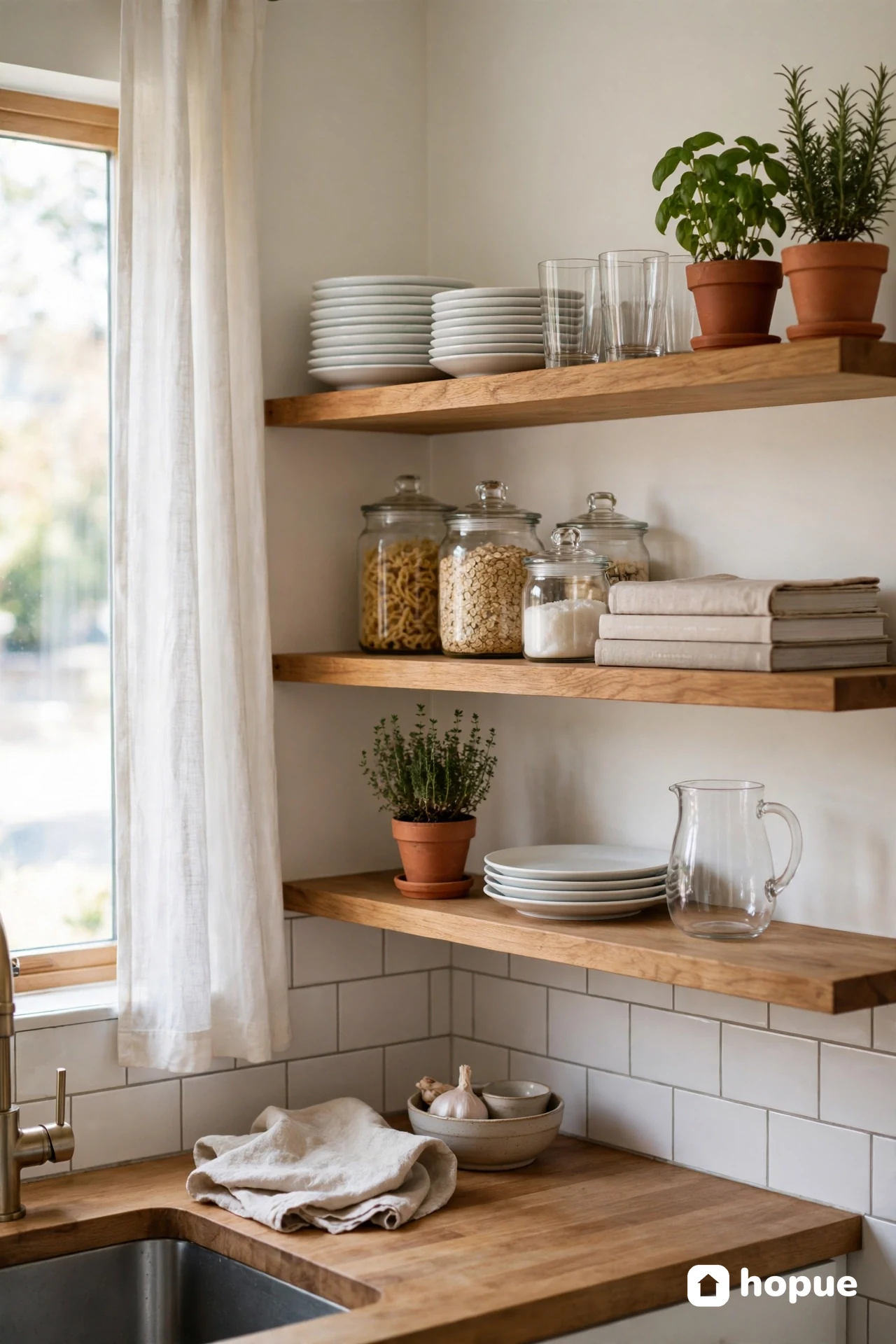
Start with the plates you eat from, not the ones saved for guests who never come. Stack them on the easiest shelf to reach, rims lined up, largest at the bottom. I did this in my first rental after keeping my good plates hidden in a cabinet and using the same two chipped ones for months. It felt silly once I saw them there. White plates are easiest because they go with food, other dishes, and whatever else ends up beside them. If yours are mixed colours, stack by colour and let that be the pattern.
2. Line Up Clear Glasses and Let Light Do the Work
Clear glasses need almost no styling. Line them up in a loose row, facing the same way, and let window light hit them in the morning. Water glasses, wine glasses, and the odd jam jar kept for its shape can live together if clean and roughly the same height. I keep the ones I use most at the front. The tall, fancy ones go at the back where they won’t get bumped every time I reach for water. Dust shows fast on glass, so a quick rinse before guests come over is normal, not a failure.
3. Give Your Mugs Their Own Shelf
Mugs are where a kitchen starts to look like someone lives there. Give them one shelf, or one end of a shelf, and group them by colour or by size. The big morning mugs together, the small tea cups together. A chipped favourite can stay. Mine has a faded stripe and a handle slightly too small, and I still reach for it first. If you have far too many, keep the ones you use in a week and box the rest. A shelf packed tight with mugs looks busy even when the mugs are lovely.
4. Keep Cookbooks You Actually Use Spine-Out
Cookbooks look great on open shelves when they are the ones with stained pages and bent corners. Stand them upright, spines out, grouped by how often you cook from them. The weeknight book goes where you can pull it down with one hand while the pasta boils. A heavy book lying flat can hold a small plant or a jar, and it stops the row from tipping over. I stopped buying cookbooks just for the cover after I realised the prettiest one on my shelf was the one I had never opened. Now the worn ones get the best spot.
5. Grow Herbs You Will Snip While You Cook
A small pot of basil or mint on a shelf near where you chop is useful, not just pretty. You will use it if you can reach it without moving three other things. Parsley holds up well indoors. Mint will try to take over, so give it its own pot. Put a saucer underneath and wipe it when you water, because water rings show on wood fast. If your kitchen gets little light, try chives or parsley first and see how they do for a few weeks before you buy more. One healthy pot beats four sad ones.
6. Fill Glass Jars With What You Already Buy
Rice, pasta, oats, lentils, and flour look calm and tidy in clear glass jars, and you can see when you are running low. You don’t need matching lids or matching jars. I use a mix of old pickle jars and two jars I found at a thrift shop, and the mix looks more like a real kitchen than a set would. Keep the jars you open daily at hand height. Put baking supplies you use once a month higher up. Label them only if you mix things up. Most renters know their own rice when they see it.
7. Hide the Mess in One Good Basket
Every kitchen has things that are useful and ugly. Spare batteries, sauce packets, tea bags in torn boxes, the charger you always lose. One basket with a lid, or a deep woven basket, swallows all of it and still looks tidy on a shelf. Put it on a middle shelf where you can reach in without standing on a chair. Mine holds vitamins, spare light bulbs, and the small tools I use to fix wobbly chairs. Nobody needs to see that. The basket itself becomes the decor, so pick one you like the look of.
8. Lean Cutting Boards Like Art
Wooden cutting boards are made to be leaned against a wall. Stand two or three upright, tallest at the back, and let the wood grain show. A round board in front of a rectangular one breaks up the straight lines. Use the boards you cook with, and wash and dry them well before they go back. A board with knife marks tells a better story than a perfect one never touched. If you only own plastic boards, lean one wooden serving board instead and keep the plastic ones in a drawer. The wood warms up a whole shelf.
9. Let One Handmade Piece Take the Spotlight
One odd, handmade piece does more than five matching ones. A lopsided bowl from a market, a mug with a thumbprint in the glaze, a plate your friend made in a pottery class. Put it where your eye lands first, with plain things around it so it stands out. I have a small blue bowl that is too small for soup and too pretty to hide. It holds garlic now, and people always ask about it. Give that one piece space. Crowding it with other special things just makes them all compete.
10. Pick Two Colours and Stick to Them
Open shelves look calm when most things share two colours, plus white and wood. Pick the colours you already own. Maybe sage green and cream. Maybe navy and warm wood. Maybe terracotta and white. Then, when you buy a new mug or towel, check it against those two colours before it earns shelf space. This isn’t about being strict. It’s about stopping the slow pile-up of every colour at once. My shelves settled on cream and deep green because that was what I kept reaching for, and shopping got easier after that.
11. Mix Warm Wood With Cool Metal
Wood and metal balance each other. Wood feels warm and soft. Metal feels clean and a bit sharp. Put a wooden board next to a steel canister. A brass spoon rest beside a wooden spoon jar. A metal tray under wooden bowls. If everything is wood, the shelf can look heavy. If everything is metal, it can feel cold, like a shop. I noticed this when my shelves were all wood and glass and the wall looked brown. One steel pot and a metal basket changed it. You don’t need new things. Move what you have.
12. Lean a Small Print Against the Wall
A small framed print, leaned against the wall at the back of a shelf, adds a bit of you to the kitchen. It could be a market poster, postcard, trip photo, or recipe card written by hand. Keep it small and keep it behind the dishes, so it peeks out rather than taking over. I use a postcard from a seaside town, tucked behind a stack of bowls. The frame gets a bit steamy near the stove, so I keep art away from direct heat and wipe the glass now and then. Swap it when you get bored.
13. Let a Trailing Plant Soften the Edge
A trailing plant does what nothing else on a shelf can do. It softens the hard edge and drops a bit of green down the wall. Pothos is forgiving for renters. It copes with low light and being forgotten for a while. Put it on the top shelf or at the end of a shelf, and let a few stems hang down. Trim it when it gets in the way of cooking. Check the pot has a tray, because drips stain shelves and annoy landlords. Fake plants work too, but a real, slightly wild one looks better.
14. Swap One Shelf With the Seasons, Not the Whole Wall
You don’t need to restyle the whole kitchen for autumn or spring. Pick one shelf, the one you see first when you walk in, and change just that. A small pumpkin in October. Fresh lemons in a bowl in summer. Pine branches in a jar in winter, if you like that sort of thing. The rest stays as it is, which saves time and money. I keep a small box of seasonal bits in a closet, and swapping that one shelf takes ten minutes. It feels fresh without turning the kitchen into a holiday display.
15. Style the Shelf Above the Sink for Daily Use
The shelf above the sink gets splashed, steamed, and reached for with wet hands. Style it for that life. Soap, a small dish brush in a jar, a stack of clean dish towels, and a glass or two. Pretty, but washable. Avoid paper, loose photos, or anything that will warp. I learned this after a paper print curled up in a week above my sink. Now that shelf holds a soap dispenser I like, a plant that enjoys the steam, and nothing I would mind getting wet. It looks tidy because everything there earns its place.
16. Treat a Full Wall as Three Zones
A full wall of open shelves can feel like a lot. Think of it in three zones instead. Top zone for things you rarely use and pretty things you like looking at. Middle zone for daily dishes, glasses, and mugs. Bottom zone for heavy things, pots, and anything you grab while cooking. This keeps heavy items low, where they are safer, and stops you climbing for a plate every night. When I first had a full wall, I put heavy bowls up high and regretted it the first time one slipped. Low and heavy, high and light, works.
17. Keep Cooking Tools on the Bottom, Display Up Top
If you cook most nights, your cooking tools need to live low and close. Spatulas, tongs, and wooden spoons in a jar on the bottom shelf. Oils and salt nearby. The pretty, rarely touched things go up top, where you can admire them without moving them daily. This split stops the shelf from looking like a museum. My bottom shelf is a bit messy by dinner time, and that is fine, because it gets used. The top shelf stays calm. Both jobs matter, and they do not have to be on the same shelf.
18. Mix in Thrifted Finds for Character
Thrift shops are made for open shelves. An old teapot, mismatched saucers, a tin box with a faded label, a glass vase that cost next to nothing. One or two finds mixed in with your everyday dishes give the shelf character that new sets cannot fake. Check thrifted dishes for chips and cracks before using them for food. Wash them well. I found a set of green glass dessert bowls that I use every week now, and they cost less than a takeout lunch. New things are fine too, but the odd old piece makes it yours.
19. Fold Tea Towels Like Part of the Display
Tea towels are decor when they are folded well and stacked in plain sight. Fold them in thirds, stack two or three, and put them where you can grab one. Choose towels in your shelf colours, or plain white with a stripe. Avoid the novelty towel with a joke on it unless you love it, because you will see it daily. I keep one good linen towel on top of the stack for guests and use the everyday cotton ones underneath. When a towel gets stained, it moves to cleaning duty and a fresh one takes its place.
20. Decant Oils and Spices Into Bottles You Like Looking At
Cooking oil in its shop bottle, with a bright label and a plastic pourer, can jar with an otherwise calm shelf. Pour oil and vinegar into plain glass bottles, and keep salt in a small pot or jar with a lid. Weekly spices can go in small matching jars, if you like that look, or stay in their tins if tidy. Keep the rest in a basket or a closed cupboard. I decanted olive oil into a green glass bottle and suddenly the shelf looked intentional. Just label anything that could be mistaken for something else.
21. Add Warm Light Without Wiring Anything
Open shelves look flat under a single ceiling light. A battery light, plug-in strip tucked under a shelf, or tiny lamp on a wide shelf can warm the corner. Renters cannot rewire, but stick-on lights and plug-in options do the job without damage. Put the light where it hits dishes and glass, not where it shines in your eyes. I use a small warm light under my top shelf, and in the evening the kitchen feels softer, even though nothing else changed. Turn it off when you leave, and keep lights away from steam and splashes.
22. Stack Bowls by Size and Use Them
Bowls stack neatly and look good doing it. Put the largest at the bottom, smallest on top, and keep the stack where you serve food. Cereal bowls, soup bowls, and one or two serving bowls are enough for most renters. If you own twelve bowls and use three, the rest can live in a closed cupboard. I kept buying pretty bowls and ended up with a wobbly tower. Now I keep five that I use, and the shelf feels calmer. A stack that leans is a sign to take a few bowls off, not to push it back.
23. Make a Small Tea and Coffee Corner
If you make tea or coffee every morning, give it a corner of one shelf. Kettle nearby, mugs above, tea box or coffee jar beside them, and a small spoon jar. Everything for that first cup in one spot means less hunting before you are awake. Keep sugar and honey in small jars with lids so they do not get damp. My corner is just one end of a shelf, but it saves me opening three cupboards half asleep. If you do not drink coffee or tea, skip this idea. A shelf for something you never use is wasted space.
24. Put Everyday Utensils in a Crock, Not a Drawer
A heavy crock or tall jar on a shelf holds the utensils you reach for while cooking. Wooden spoons, a whisk, tongs, a spatula. It frees a drawer, and it looks like a working kitchen. Pick a crock that will not tip when it is half empty. Stoneware and thick glass work well. Plastic cups tip too easily. I keep mine on the lowest shelf, near the stove but not so close that handles get hot. Wash the utensils often, because dust settles on anything left out. A crock with only the tools you use stays tidy.
25. Pair Pattern With Plain So Neither Fights
Patterned dishes are lovely until they all shout at once. Pair one patterned stack with plain things around it. Striped bowls beside white plates. A floral mug among plain mugs. A checked tea towel under plain jars. The plain pieces give your eye a rest, and the pattern gets room to show. I have a set of blue patterned plates that looked too busy when they filled a whole shelf. Mixed with white bowls and clear glasses, they look like a choice, not clutter. If you love pattern, let one shelf carry it and keep the next shelf quiet.
26. Leave Breathing Room on Purpose
The hardest styling choice is leaving space empty. Not every inch of a shelf needs filling. A gap between stacks lets you grab a plate without moving a jar. It also makes the things you keep look more deliberate. I used to fill every gap with a small jar or a candle, and the shelves looked crowded even though I owned very little. Now I leave a hand-width of space at the end of each shelf, and the kitchen feels bigger. If a shelf looks bare, move one good thing into the gap instead of three small things.
27. Add One Personal Thing That Is Not Kitchenware
One thing that is not for cooking makes a shelf feel like home. A souvenir from a trip, photo in a sturdy frame, shell from a beach walk, tiny plant pot a child painted. Keep it to one per shelf, or one per wall, so it stays special. It should be washable or easy to dust, because kitchens are greasy. My shelf holds a small wooden bird from a market trip, tucked behind the mugs where I see it when I reach for coffee. It has nothing to do with cooking, and that is why I like it there.
28. Raise Short Items on a Stack of Books
Short jars and small bowls can disappear behind taller things. Raise them on a flat stack of two or three books, or on a small wooden box. The lift makes them visible and adds a layer to the shelf. Use books you do not mind in the kitchen, not a library book. A cookbook you rarely open works well as the base. I use a thick baking book under a small plant, and the plant finally gets light instead of hiding behind the glasses. Make sure the stack is stable. If it wobbles, take a book off.
29. Group in Threes, Then Step Back
When a shelf feels off and you can’t say why, try grouping things in threes. Three jars together. Three mugs together. Three boards leaned in a row. Odd groups tend to look more relaxed than neat pairs or long rows. After you group them, step back and look from the doorway, where you see the shelf most days. That view matters more than how it looks from close up. I do this every time I tidy my shelves. Half the time I move one thing, step back, and it suddenly looks right. Trust the doorway view.
A shelf that works for your real life will beat a perfect shelf you are scared to use. Start with one shelf, keep what you reach for, and let the rest find its place over time. Your kitchen doesn’t need to look finished today to feel like home tonight.
Frequently Asked Questions
How do I keep open shelves from getting dusty and greasy in a rental kitchen?
Dust and grease are the honest downside of open shelves, especially near the stove. Keep everyday dishes on the shelves and wash them as you use them, so dust never gets a long stay. Put rarely used pieces higher up or in a closed cupboard, and wipe shelves with a damp cloth when you clean the counters. A small fan or open window while you fry helps, and a quick wipe of jars and bottles once a week keeps grease from building up. If your stove has no good vent, keep the shelf right above it for washable items only, like plates and glass, not for linens or paper.
What should I put on the top shelf I can barely reach?
Use the top shelf for things you need rarely but like looking at. A vase, a stack of serving bowls for guests, spare glasses, or a plant that does not need daily watering. Avoid heavy pots, daily plates, or anything you would have to climb for with wet hands. Keep a small step stool nearby if you need one, and check that tall items are stable and pushed back from the edge. If you never reach it, it is display space, and that is fine, as long as the shelves you do reach stay useful.
Can I style open shelves if I only have one short shelf?
Yes, one short shelf can still carry the look. Pick a tight group: a stack of plates, two or three mugs, and one small plant or jar. Leave a gap at one end so it does not look crammed. Choose items in one or two colours and keep everything you put there useful, because there is no room for extras. A single shelf above a sink or beside a window often looks best when it holds daily items, not a full display. Add one personal touch, like a small print, if there is room, and stop there.
How do I stop open shelves looking cluttered when I actually cook every day?
Clutter usually means too many things competing, not too much cooking. Keep daily tools in one crock or basket, corral small items on a tray, and leave breathing room between groups. Put back dishes in the same spot after washing, so the shelf resets itself. If a shelf still looks busy, take three things off and live with it for a few days before adding anything back. Most renters find the shelf calms down once every item has one home and the extras live in a closed cupboard, out of sight until they are needed.